
How To Fix Green Pool Water
SwimmingPoolSteve.com is user-supported. In order to keep this resource about pools and spas available for free to all readers I earn commissions for purchases made through links on this page. For more information see the full disclaimer page. By using this website you are agreeing to the terms and conditions.

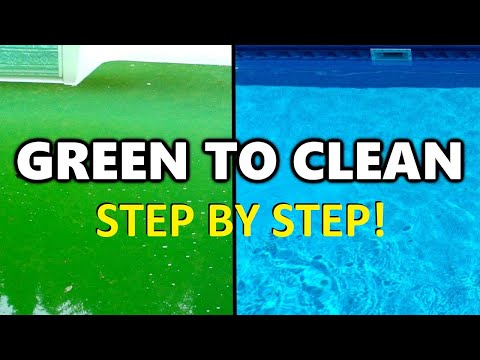
If you are looking for instructional information about the steps involved with cleaning up a green swimming pool then this page (and video) will definitely help you to do this. "Green to clean" is the slang name for the pool service of fixing green water in a pool, usually within the shortest amount of time possible. So calling a local pool company for a green to clean service for example would involve multiple trips to your home for vacuuming, brushing and most especially chemical maintenance in the water over a few days time. While you can actually clear up a green pool in as little as 12 to 24 hours (in some cases) most will take between three to seven days to clear fully with about five days being average for a green to clean pool.
The difference in the amount of time it can take for a green to clean pool is due to the different conditions the water can be in, combined with the quality of the pool filtration system including number of pipes, size of pipes, flow rates, filter type and filter size. Also the volume of the pool will make a significant difference as well. The larger the pool the harder it is to turn it around when it is green, the longer the chemicals take to work, the more of them you need, and the greater the amount of time required to complete one turn over of the pool volume through the filtration set. In short, smaller pools are easier and faster to clear up than larger ones. Let's dive into the steps required to change your pool from green to clean:

Green To Clean Pool Water Step By Step
There are a host of variables which you need to know, and balance, in order for your pool water to be clear. If the water is green there is almost certainly one, if not multiple things, wrong with your water chemistry currently If you know what to look for in your water chemistry tests you can usually tell at a glance exactly what is wrong and what it will take to clear up your green water. This is why detailed water testing is so important if you want to actually fix your green water.
Learn how to get help with your pool water chemistry
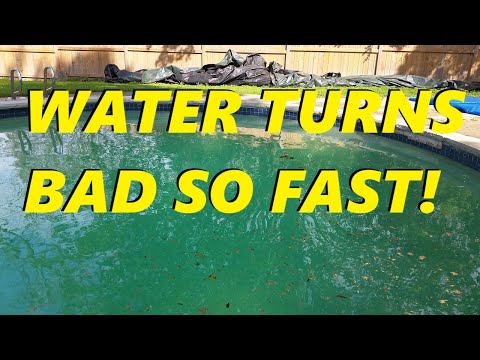
One of the biggest causes for running out of chlorine (suddenly) and developing green water and algae growth quickly is from rain. Rain will actively reduce your free chlorine levels and if you had just barely enough chlorine before it rained you could wake up the next morning to green pool water...it can happen just that fast! The warmer your water and the greater the organic debris load the faster your pool water will turn green once it runs out of free chlorine. The catch that seems to get a lot of pool owners is when you have minimal chlorine - not zero yet - but you also have something else wrong with the pool chemistry like high pH or high CYA levels which contribute to the chlorine being less able to function. Marginal water chemistry like this can also result in green pool water and a higher free chlorine level (chlorine reserve) would help to eliminate bouts of green water like this.
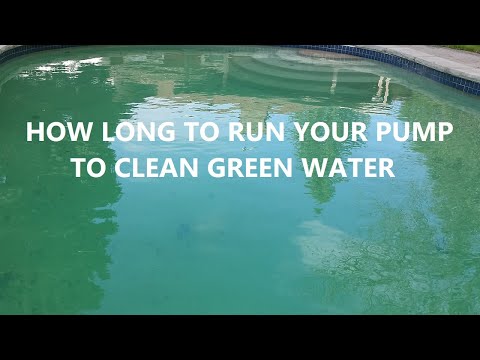
Run your filtration system 24/7 to clear green water - Even if you typically run a reduced operating schedule for your pool pump every day you will want to be running it 24/7 until the water has cleared up. If you have green water in your pool this is no time to be pinching pennies on your pump operating costs. Be sure to clean your filter and note the clean operational pressure on your filter. When the pressure increases around 7 PSI this indicates it is time to clean the filter again. This can happen often and quickly when you have green pool water so watch your pressure closely. Never let your pool system operate above 30 PSI for any pool. So clean operational pressure plus 7 PSI, or 30 PSI total, whichever comes first - this is how you know when it is time to perform your filter cleaning maintenance.
When to NOT run your pool pump clearing green water - The only time you should not run your pool pump when you are cleaning green water would be if you are attempting to use a flocculant in your pool water. These are designed to coagulate impurities within the water together and sink them to the bottom of the pool. This requires that your pool filtration system be turned off for a period of time, usually overnight, and then in the morning you vacuum the debris which has settled onto the floor to waste (not into the filter). Floc treatments are something that pool professionals use to aggressive and quickly clear green pools, but you should be aware that this can be a problem for your filter depending on what kind you have. Usually you must bypass your filter media for treatments like this, which is easy on a sand filter, and harder on any other filter. Exposing your filter media to flocculants can cause damage to them. Most pools will not need flocculant to clear green water. Simply run your filtration system and adjust the chemistry to the ideal ranges and the pool will clear without additional treatments being required.
Green to clean pool water chemistry - In almost every case the problem with green water that will not clear is a result of one or more of your fundamental water chemistry parameters being out of place. Testing and rectifying this problem will almost certainly result in the pool clearing up in about 24 hours or less. Most commonly, the CYA of the pool is too high and this is preventing your chlorine from working properly, or the presence of combined chlorine is stopping the water from clearing up. You really need to go through your water chemistry systematically but jumping ahead, these two common offenders are something I would be looking for in your water test results. A pool with CYA too high or a pool with high combined chlorine levels will not clear even if you are doing every other thing correctly.
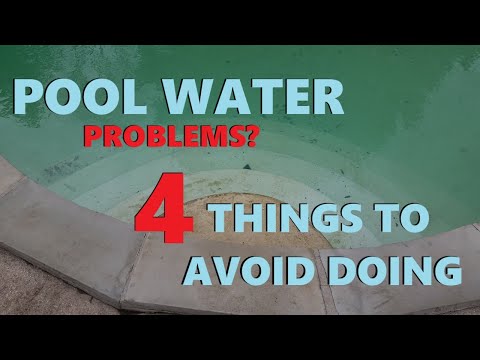
The water chemistry is not "good" or we would probably not be talking about your green pool water and how to fix it. Further to this, and this is the point here, pool owners fail to recognize the importance of water chemistry readings.
When a pool professional inquires about how your water chemistry is what they are expecting to hear in return is a systematic list of all of your chemical parameters including numerical values. The origin of this problem is from pool test strips, the lowest common denominator for pool water testing, because they tend to use basic terms like "low, high, and ideal range" when in reality you should know these ranges already off by heart, and you should determine for yourself whether a number is good, bad, or otherwise. Here is the minimum information that you must come armed with if you want to have a discussion with a water chemistry expert as to why your pool water is green:
Total Alkalinity - 60 to 180 ppm (100 to 120 ppm optimal range)
pH - 7.2 to 7.8 (7.4 to 7.6 optimal range)
Calcium Hardness - 150 to 1000 ppm (200 to 400 ppm optimal range)
Free Chlorine - 1 to 5 ppm (2 to 4 ppm optimal range)
Combined Chlorine - 0 to 1 ppm (0 ppm optimal range)
Cyanuric Acid (CYA) - 20 to 70 ppm (30 to 50 ppm ideal range)
Phosphates - 0 to 1000 ppb (under 500 ppb optimal range)
Copper - 0 ppm
Iron - 0 ppm
Yes that is a lot of numbers to remember. Fortunately for you we live in a day and age where everyone carries a supercomputer in their pocket 24/7 that is connected to a collective database of the entire knowledge of mankind. Your grandparents just had to know this stuff. You really don't have an excuse, except for that everyone is so busy these days that who has time to learn pool chemistry! Make it easy on yourself and just take a picture of your screen right now and you will have most of the information that you need to maintain your pool chemicals all in one picture. Of course you can also just bookmark this page, or my whole website, and come back here every time you have a question about your pool or your water.
Pool water needs chlorine. it is not enough to add some, so there "must" be some in there, right? You need to add chlorine to the extent that you are able to build, and hold, a residual value in the water. This ability to build and hold a residual value is one of the unique factors that makes chlorine the gold standard for pool water care. If you can, at any time, measure your chlorine level and it is equal to zero then this is the reason for your green water. Without a sanitizer in the water, your pool immediately begins to grow bacteria and organic matter. How long it takes to turn green depends on your filtration quality, water temperature and amount of sun exposure, but zero free chlorine means green pool water with certainty.

In perfectly balanced pool water combined chlorine should be zero. By 1.0 ppm of combined chlorine your water is being strained by this combined chlorine level making the water appear dull and listless looking, and less responsive to normal chemical treatments. In order to eliminate combined chlorine you need to perform breakpoint chlorination. This involves increasing the free chlorine level to be 10 times the combined chlorine level and hold it sustained for over 12 hours. So a combined chlorine level of 1.0 ppm would be resolved by increasing free chlorine to 10.0 ppm and holding it here for over 12 hours. If the free chlorine level drops during this time it must be increased back to 10.0 until 12 hours time has passed.
On the other end of the spectrum, having a CYA level that is too high is one of the single most common reasons that new pool owners will have their water turn green. This will be especially confusing to pool owners, because the water test will still show that you have some chlorine but the water is acting as though you have none (turning green). This happens if your CYA levels get higher than 80 to 100 ppm. Chlorine pucks and other forms of stabilized chlorine products contain CYA and so every time you add them to your pool your CYA levels are increasing.
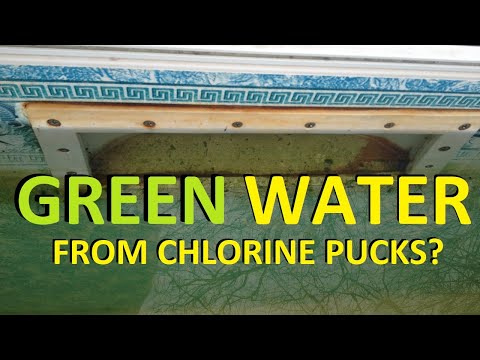
The use (over-use) of stabilized chlorine pucks is one of the most common causes for green pool water. If you just buy and use chlorine pucks / tabs regularly and you do not regularly test and monitor for your CYA / stabilizer level then this is likely where the green water problem started. Stabilized chlorine pucks have a lot of CYA in them...you are adding almost 1ppm CYA for every 1ppm free chlorine you are adding! Choosing a chlorine type which is not stabilized and maintaining your CYA at 30 to 50 ppm is the long term solution here.
Green Pool Water From High pH Levels - The next logical cause for green pool water, after you have established that you have a free chlorine residual, and that you have CYA in the range of 30 to 50 ppm, and definitely not above 80 ppm, you should consider your pH levels. The optimal pH for your chlorine to be functional is actually a much more acidic level than your body would be comfortable soaking in. Specifically chlorine would be way more effective in your water at acidity levels closer to beer or black coffee, which is around 5.0 or so. You might think that sounds low, especially when you look at your pH and see it at 8.0 or above (which is very common, especially in salt water pools), but you might not realize the pH scale is logarithmic. A pH of 5.0 is one thousand times more acidic than a pH of 8.0. Want to go for a dip? Unfortunately people do not tolerate acidic pH like that very well at all, and so we keep the pH closer to what is comfortable for us, ideally 7.4 to 7.6 but, this is a compromise with the chlorine effectiveness. Yes, when kept at 7.4 to 7.6 your chlorine can function and do its job and you can be comfortable at the same time. However this is the very upper end range for where chlorine can work. You just assume that you put chlorine in water and Bob's your uncle...but it is a sensitive balancing act of chemical interactions which arrives at clean and safe water. By the time you pH climbs to 8.0, which it can do easily, readily and all the time, your chlorine is barely keeping up. By 8.2+ which represents the maximum range for many pH testing methods the chlorine is almost completely inactive in the water. You can test for it, and it is there, but it can not kill bacteria or inhibit organic growth. It is worth noting that pH in particular is challenging to test for in your water. Test strips for free chlorine levels are fairly effective for a quick check, but the pH much less so. The color scale for measuring pH with test strips is vague at best, and each person will view and interpret the colors a little differently. It would be helpful for pool owners to know and understand that this limitation with pH testing is one of the main reasons that you should invest in a more advanced home test kit like this complete Taylor pool & spa test kit
 .
.
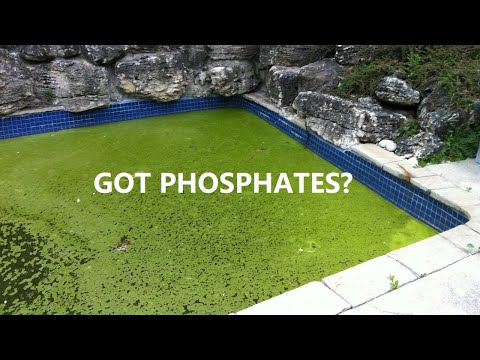
Phosphates promote voracious organic matter growth. As described to me, phosphates are like a super flood for organic matter growth and algae. Given the right mix of phosphates, nitrates, organic matter, UV and water temperature you can see explosive growth in matter that is enough to choke the life from open waterways. A stagnant body of water like a pool with a modest filtration system is simply not able to keep up with plant matter that grows this quickly. This is why we measure phosphates in parts per billion instead of the normal parts per million that we use for so many chemicals in pool water. Above even 500 ppb phosphates will be requiring you to use more chlorine than you normally would. At 1000 to 2000 ppb the chlorine can not keep up with the growth of organic matter, and your pool will be green despite daily chlorine treatments. If you have elevated phosphate levels in your pool you must use a phosphate remover product like natural chemistry phosphate remover.
Testing & removing phosphates in pools

If you rely on a water lab for your water tests you often need to ask specifically to have phosphates tested as this individual test is more expensive than the regular chlorine, alkalinity and pH testing you have done. You probably would still not have to pay for the test, just that many do not include it unless you ask about it. You can also test for phosphates pretty easily with these easy phosphate test strips. These are good as most test strips only test phosphates to 1000ppb where as these test to 2500ppb which you definitely can encounter in pools.
For removing phosphates from pools I like Phosfree from Natural Chemistry. Be sure to read and follow the instructions for this product. Cloudy water is normal to encounter during phosphate removal.
Green Pool Water From Copper - You have tested and verified a free chlorine level between 30 to 50 ppm. You have a CYA level between 30 to 50 ppm. Your alkalinity was set to 120 or so (alkalinity before pH) and then pH adjusted to 7.4 to 7.6. You tested for phosphates and have zero, or well less than 500 ppb, or have used phosphate remover to get less than 500 ppb, and your pool water is still green. You might be getting frustrated thinking none of the answers are solving your problem, but the nature of solving swimming pool problems often boils down to a process of elimination. It is helpful that we have eliminated all of the things above this point as the potential cause for your green water. If you have worked to establish your chemicals as listed in the above paragraphs, and then you have been patient for at least 48 hours to let the pool chemistry fully adjust to the changes that you have made. In short, give the pool a day or two to respond to your improved chemical parameters, such that the water has a chance to start to clear up. Assuming you did all of that and still the water is green, the list of potential causes grows shorter. We need to look towards less common causes for your green water.
One of those less common but entirely possible causes for unexplained green pool water is oxidized copper. If you have copper in your pool system anywhere that is dissolving into solution it can turn green when it is oxidized by your chlorine. Chlorine is an oxidizer, and copper turns green when it oxidizes. You could have copper pipes in your system as many older pools did. You could also be putting the copper in yourself from something like a mineral system, or copper ionizer, or from algicides that contain copper, or from a failing and corroding pool heat exchanger...there is actually a lot of ways you could end up with copper in solution in your water, and when you add a bunch of chlorine your pool turns green suddenly right before your eyes. It has a unique coloration, in that oxidized copper in pool water will be bright, emerald green, but the water should still be largely clear. Green from organic matter growth normally makes the water cloudy and turbid, but oxidizing copper will look like clear, lime jello pool water. Just like when this happened with the world watching at the Rio Olympic Games when hydrogen peroxide was added manually to the diving tank pools and the pool instantly turned a bright green color. Have your water tested for copper or buy some copper test strips
 for testing at home. Your value should be zero. Examine the chemicals and peripheral items you have installed to see if there is a source of copper you are unaware of. Treatment of metals in pool water is a complicated subject with a few different ways to approach long term treatment such as sequestering agents or chelating agents to hold metals in solution and prevent them from oxidizing, but then you could also approach the problem from the direction of a flocculant or coagulant, like alum to drop the metals out of solution such that they can be controlled and removed from the pool completely. The best solution for you depends on what your levels are, and how these metals are getting into your pool water.
Green Pool Water From Poor Filtration - Water filtration in swimming pools is one of the major fundamental subjects that is simply approached incorrectly by the vast majority of pool owners. It is terribly common to hear pool owners say they measure filtration schedule in "hours per day" of pump run time. When communicating with other pool owners this can be very misleading if you fail to appreciate that every pool is different, and even two identical equipment systems will operate differently on two different pools. When you account for the fact that some pools are small and some are big, and some filtration pumps are small and some are massive, we would be ignoring a ton of important data to just say "run your pump eight hours per day". There is only one correct way to measure pool filtration, and that is simply to turn over the volume of your pool through your filtration system three times every 24 hours. This results in about 95% of all the water in your pool being filtered at least one time. Which is the goal. Your goal is to filter all of the water in your pool every day. This is the established standard to which you must strive to achieve if you want to filter your pool water "properly". The only other option you could argue is that you should turn over the water in your pool four times every day, which results in about 98% of all of the water in your pool being filtered every day. Anything other than this exact approach is ignoring important technical data. So why do people do this? The answer is shockingly simple.
To measure filtration properly you need to know how much water your pool system is moving. To know this you would need a flow meter. Commercial pools have flow meters because they need to actually know this information and follow the rules for safety and to pass regular inspections. If you had a flow meter you could calculate your pool turnover rate as well, which would be great because not only could you know if you are actually filtering the correct amount of water, but you will also know everything you need to know in order to dial in the filtration (and savings) with a variable speed pump. For more information about how the industry ended up like this, and how variable speed pump requirements by the department of energy will see more residential pools with flow meters moving forward, you can read this article about why pools need flow meters. If you have green water in your pool then you should abandon any discussion of reduced filtration schedules. Filtration schedules apply to clean and clear pools. If you have a green pool water problem that you are trying to solve then you would be well advised to run your filtration pump 24/7 until the pool water is sparkling clear. If you have only been running your pump a few hours per day while trying to resolve a green water problem then this certainly is working against your efforts to clear the water.
Even better than fixing green pool water would be to notice that the pool is about to turn green and start your remediation process early. Why wait until you have a deep, dark green swamp before you begin to test and correct the water. Before pools turn green they will always give you the symptom of cloudy water. This is actually the same algae and plant matter growth that will eventually turn the water green...just the earliest stages of it. Watch this video to learn how to spot cloudy pool water and what to do to clear it up and prevent your pool from turning green.
Green Pool Water From Chemistry Versus Filtration
Run your pool filter 24/7 and consider using floc treatments if your pool is extremely green. Be sure to watch your filter pressure and clean when the filter pressure rises 7 PSI or so above clean operation pressures for your pool. Do not leave a solar blanket or pool cover on during the daytime when you are trying to clear up your water. Scoop, brush and vacuum your pool as often as it looks like it needs it, once per week at minimum. More if you have a lot of debris in your pool. Keep your skimmer and pump strainer baskets clear of debris. If you follow these steps you will take your pool from green to clean quickly!
Shades of Green - A funny look at just how gross pool water can get!
Top content from www.SwimmingPoolSteve.com
Pool and spa chemistry crash course
New pool owner guide
The Swimming Pool Steve blog
Have a question - ask Steve

Swimming Pool Steve is an award winning, second generation swimming pool specialist from Ontario Canada and one of the most trusted voices in the swimming pool industry. With over 20,000,000 views on the Swimming Pool Steve YouTube Channel, winner of the Pleatco Pool & Spa Industry Leadership award and author of hundreds of pool and spa articles both online and in print. Steve is committed to helping pool and spa owners as well as pool and spa industry workers learn more about the technical side of building, renovating, repairing and maintaining all types of swimming pools and spas. Follow Swimming Pool Steve on Facebook, Twitter and YouTube.
Paid PDF Books From Swimming Pool Steve
 Steve's Pool Survival Guide
The Swimming Pool Steve Pool Survival Guide is intended to help pool owners understand their pool and pool equipment better, understand water chemistry, water testing and chemical corrections to the water, troubleshoot the most common pool problems and have confidence in interacting and caring for their pool in the fastest possible frame of time. Also covers pool safety, things to avoid and how to operate your pool more efficiently.
 Salt Water Recommendations
Are you considering upgrading to salt water in your pool? In this paid PDF Steve talks about which pools should avoid using salt water. Find out concerns about using salt in your pool but also the potential benefits of salt water. Finally hear which specific brand and model of salt chlorine generator Steve thinks is the best option currently available to pool owners and how to choose the right size salt system for your pool.
 New Pool Heater Buyer's Guide
In this guide Swimming Pool Steve will help you to better understand your heater options as well as which would be best suited for your pool. Learn about BTU output and sizing of both gas/propane heaters as well as electric heat pumps for residential swimming pools. You will also learn about which specific brands and models of currently available pool heaters Steve likes to recommend. If you are thinking of adding a new pool heater to your equipment pad this buyer's guide would be a useful resource to help you make a more informed buying decision.
 New Pool Installation Value Guide
This is a value shopping guide written by Swimming Pool Steve to help home owners hiring for a new pool installation to get the maximum value for their investment with tips about how to protect your interests during the vetting, hiring and pool installation process. Anyone serious about having a pool installed will find value in this guide. Pool installers will sell the pool package that is best for them - not for you! Become an informed value shopper with this PDF guide.
Endorsed Brands From Swimming Pool Steve
The following links and products are to affiliates of the Swimming Pool Steve website. These are brands, products and services hand selected by Steve for endorsement. Please note that these endorsements can include monetary compensation, affiliate links and referral fees to Swimming Pool Steve, however there is zero additional cost to you should you use one of these products or services. Income generated from these links helps to keep this pool and spa resource available for everyone. To have your product or service considered for listing here as an endorsed brand email SwimmingPoolSteve@gmail.com.
Amazon Disclosure Statement - As an Amazon Associate I earn from qualifying purchases.

www.PoolPartsToGo.com
New Black + Decker variable speed pumps are available online from www.PoolPartsToGo.com and they are a drop in replacement for many popular pump models including Pentair Superflo and Hayward Super Pumps. With an adjustable platform base, union connections included and a very strong warranty these pumps offer an impressive value to pool owners.
- Swimming Pool Steve