
How Many Returns Does A Pool Need?
SwimmingPoolSteve.com is user-supported. In order to keep this resource about pools and spas available for free to all readers I earn commissions for purchases made through links on this page. For more information see the full disclaimer page. By using this website you are agreeing to the terms and conditions.
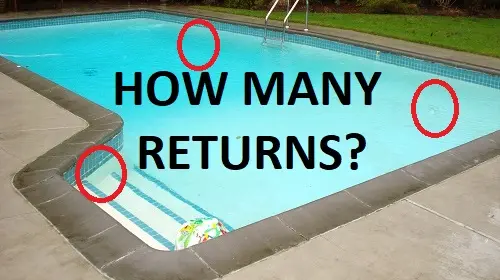
How many returns does a swimming pool need for bringing filtered and chemically treated water back to the pool? The answer to that question is one return, at minimum. So now let's ask the real question you want to know the answer to and this is how many returns should a pool have? The answer to this will depend on the size and shape of your swimming pool. Genuinely every swimming pool installation is unique...but to give you a very short answer to a reasonably complex technical question, the average swimming pool built today will have between two and four return lines with three being a reasonable average estimate. Now, let's break this down a little further and examine why you might want more returns than that for your pool.
When a pool company gives you an estimate to build a pool they will, in almost every case, choose a plumbing configuration which is cost effective to install. They do this to keep the sticker shock as low as possible as modern pool installations can be shockingly expensive especially when you add in all the bells and whistles you want your pool to have. Most pool owners would not even know to ask about the plumbing system and how it is designed. What size are the pipes, how many suction and return lines are there...these are critical questions that you need to know the answers to in order to determine the quality and potential efficiency of your plumbing system. Since this is one of the most fundamentally important parts of your pool you should be very interested to know more about how it will be designed.

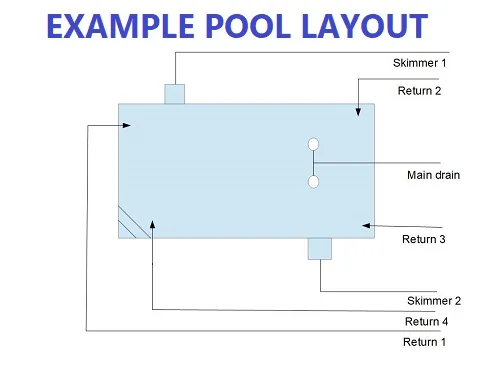
What makes a good plumbing system - In the world of hydraulics you would look at flow control, flow efficiency and total flow potential as three real world ways to measure the potential for a given plumbing system. A plumbing system with a great deal of control over how and where the flow goes is ideal. A plumbing system without any ability to close off or isolate parts of the plumbing system is considered less desirable. If you have four returns in your pool but only one pipe (and one valve) leaving the equipment location feeding these returns, this would be an example of a pool system with very poor flow control. One return trunk line feeding four individual returns means there is no actual ability to regulate flow, or turn off flow, to any of these returns. If the system was not hydraulically balanced when installed, this means you could have most of the flow of your circulation system taking the path of least resistance through one return eyelet...and there is nothing you could do about it.
Now, consider a better, more robust pool plumbing system where you have four returns in the pool, but you also have four return lines, and four valves, leaving the equipment set. With an installation like this you could manually adjust the flow to each and every return port of your pool, or close one off completely if need be. This is an example of how one plumbing system can be better than another through flow control. Flow efficiency and total flow potential are also considerations, and the answer to both of these is that smaller pipe sizes are less efficient and have less total flow capacity. Larger pipes have more flow capacity and will move more water efficiently than smaller pipes will. Investing in upgrading the plumbing system of your pool is definitely worth the money when designing your pool. For more information on flow efficiency and flow potential you can see this article about pipe size for pool installations.
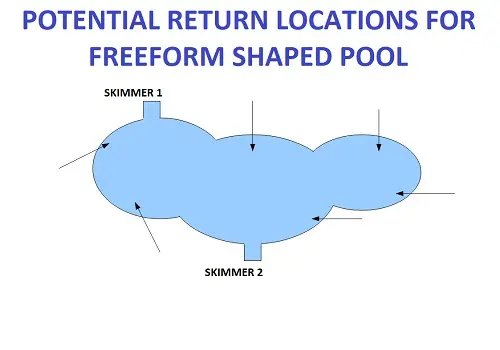
Where to place returns in a swimming pool - There are two main ways to approach placement of your returns for diffusion of clean, filtered water into your pool. One method is to place returns opposite from your skimmers and aim returns directly at the skimmers. I do not prefer this approach, though it is accepted industry practice. My preferred method for return placement in a pool is to place a return at each of the four corners of the pool, all aiming the water in the same relative direction. This will create a very weak vortex effect that will help to bring floating debris to the outside walls of the pool and then rotate the debris in one direction, like a flushing toilet bowl so to speak. If you have an oddly shaped pool then I suggest the same to have four returns, one at each corner more or less, plus additional returns as needed to aim into corners and potential dead zones in the pool. Other than the cost of the return pipes and installation there is really not a disadvantage to having 8 or 10 returns in your pool. Of course the system must be designed and balanced. You can not have one suction line and ten return lines.
Returns on pool steps and benches - In addition to the regular circulation and filtration of your pool you should also consider adding extra returns to steps and benches where debris may be inclined to collect. Where in a pool I prefer to have isolated pipe runs for each return, I tend to recommend to group steps and bench jets together in groups of two or three. So if you have three jets aiming at three step treads you want to keep clear, I usually would advise to feed these with one return line and then split (hydraulically balanced) the return line into three individual return jet locations. The steps and bench jets do not need as much blowing power as the main returns that will be vortexing your body of your pool.
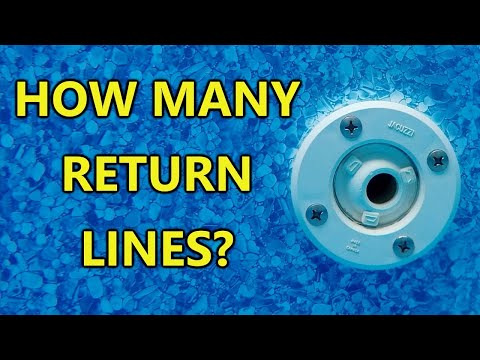
To summarize some important design aspects for your plumbing system, you should have larger sized suction lines than return lines. You should likely have more than one skimmer as this is becoming more common with modern designs. For small and medium sized pools commonly you would have two or three 2" PVC suction lines, and then four to six 1.5" PVC return lines. For a medium or larger pool the same orientation would be good, but increase the pipe size of everything so that your suction lines are 2.5" PVC and return lines are 2" PVC.
If you are still having trouble understanding the design and locations for your return lines in your pool you can always for some help with your pool. You can also purchase this pool value guide that I wrote to help people get more value for their money when getting quotes for a new pool installation: New Pool Value Guide
Top content from www.SwimmingPoolSteve.com
Pool and spa chemistry crash course
New pool owner guide
The Swimming Pool Steve blog
Have a question - ask Steve

Swimming Pool Steve is an award winning, second generation swimming pool specialist from Ontario Canada and one of the most trusted voices in the swimming pool industry. With over 20,000,000 views on the Swimming Pool Steve YouTube Channel, winner of the Pleatco Pool & Spa Industry Leadership award and author of hundreds of pool and spa articles both online and in print. Steve is committed to helping pool and spa owners as well as pool and spa industry workers learn more about the technical side of building, renovating, repairing and maintaining all types of swimming pools and spas. Follow Swimming Pool Steve on Facebook, Twitter and YouTube.
Paid PDF Books From Swimming Pool Steve
 Steve's Pool Survival Guide
The Swimming Pool Steve Pool Survival Guide is intended to help pool owners understand their pool and pool equipment better, understand water chemistry, water testing and chemical corrections to the water, troubleshoot the most common pool problems and have confidence in interacting and caring for their pool in the fastest possible frame of time. Also covers pool safety, things to avoid and how to operate your pool more efficiently.
 Salt Water Recommendations
Are you considering upgrading to salt water in your pool? In this paid PDF Steve talks about which pools should avoid using salt water. Find out concerns about using salt in your pool but also the potential benefits of salt water. Finally hear which specific brand and model of salt chlorine generator Steve thinks is the best option currently available to pool owners and how to choose the right size salt system for your pool.
 New Pool Heater Buyer's Guide
In this guide Swimming Pool Steve will help you to better understand your heater options as well as which would be best suited for your pool. Learn about BTU output and sizing of both gas/propane heaters as well as electric heat pumps for residential swimming pools. You will also learn about which specific brands and models of currently available pool heaters Steve likes to recommend. If you are thinking of adding a new pool heater to your equipment pad this buyer's guide would be a useful resource to help you make a more informed buying decision.
 New Pool Installation Value Guide
This is a value shopping guide written by Swimming Pool Steve to help home owners hiring for a new pool installation to get the maximum value for their investment with tips about how to protect your interests during the vetting, hiring and pool installation process. Anyone serious about having a pool installed will find value in this guide. Pool installers will sell the pool package that is best for them - not for you! Become an informed value shopper with this PDF guide.
Endorsed Brands From Swimming Pool Steve
The following links and products are to affiliates of the Swimming Pool Steve website. These are brands, products and services hand selected by Steve for endorsement. Please note that these endorsements can include monetary compensation, affiliate links and referral fees to Swimming Pool Steve, however there is zero additional cost to you should you use one of these products or services. Income generated from these links helps to keep this pool and spa resource available for everyone. To have your product or service considered for listing here as an endorsed brand email SwimmingPoolSteve@gmail.com.
Amazon Disclosure Statement - As an Amazon Associate I earn from qualifying purchases.

www.PoolPartsToGo.com
New Black + Decker variable speed pumps are available online from www.PoolPartsToGo.com and they are a drop in replacement for many popular pump models including Pentair Superflo and Hayward Super Pumps. With an adjustable platform base, union connections included and a very strong warranty these pumps offer an impressive value to pool owners.
- Swimming Pool Steve