
AOP In Swimming Pools
SwimmingPoolSteve.com is user-supported. In order to keep this resource about pools and spas available for free to all readers I earn commissions for purchases made through links on this page. For more information see the full disclaimer page. By using this website you are agreeing to the terms and conditions.
 AOP In Swimming Pools - Advanced Oxidation Process. Can this process help you to manage swimming pool water quality better? Quite possibly, yes. AOP and the oxidizing potential of "hydroxyl radicals" is probably the most powerful chemical process that you are currently not utilizing to your advantage in your swimming pool. This, mostly, is due to the relatively new application of AOP for water treatment systems which was first defined in 1987. We are just starting to see the emergence of AOP into swimming pool water management (and also the waste water treatment industry) and it is highly likely that these systems will grow in popularity for residential swimming pool applications...eventually.
Salt water chlorinators were invented and first in use for over 30 years before they even really started to catch on. It was not until the technology was over 40 years old before it actually took off and gained widespread interest from residential pool owners. If AOP follows a similar timeline then it might be 2040 before AOP is found in the "average" backyard swimming pool. The challenge is that the chemical process of AOP is complicated and relatively rare in swimming pool applications. The average pool guy does not know much about "radical chemistry" which deals with unstable and chemically reactive electrons...and not just really, really cool chemistry. You do not need to be a chemist to understand how AOP can be used to treat (or at least supplement) swimming pool water - but it would definitely help! Here is some essential (simplified) information and definitions that you will need to know more about if you want to learn about AOP and the potential of hydroxyl radicals for water treatment:
Advanced Oxidation Process (AOP) - Chemical treatment processes designed to remove organic material from water
Hydroxyl Radicals - Highly reactive and unstable chemical species that is the most widespread oxidizer in the lower earths atmosphere
Oxidation / Reduction Potential - ORP is the measurement of a chemicals tendency to acquire electrons, measured in Volts (or mV)

In addition to being considered the "detergent" of the atmosphere and an integral part of the removal of many pollutants and greenhouse gasses (like ozone) from our air, hydroxyl radicals are distinguished as being more reactive than pretty much anything else (except Fluorine). This is extremely significant as oxidizing potential is a huge part of swimming pool water management. Chlorine has an oxidizing potential of 1.4 volts, where hydrogen peroxide has an oxidizing potential of 1.8 volts. Ozone has an oxidizing potential of 2.1 and a hydroxyl radical has an oxidizing potential of 2.8 which is just shy of Fluorine which is 3.0 volts.
 We oxidize organic debris and pollutants in swimming pool water regularly. Non-chlorine shock is an oxidizer that many pool owners are familiar with since it is the one that advertises that you can safely go swimming within only a short while after adding to the pool. This is because non-chlorine shock is an oxidizer and is unstable and consumes electrons that it contacts in the water readily. Reductants, like organic debris, donate electrons to oxidizers. This process breaks down, or oxidizes, the contaminants, disinfecting the water. The unstable nature of the non-chlorine shock makes the process happen quickly which is why these products advertise that you potentially can go swimming not long after adding these to your pool.
Common oxidizers used in swimming pools are potassium monopersulfate, chlorine, hydrogen peroxide and ozone. Oxidizers, by nature, are unstable and have a high oxidizing potential. This is something that most pool owners and pool professionals already know about. If you add a lot of oxidizer to a swimming pool then you can reduce the amount of chlorine that you will need to use since the oxidizer will oxidize the organic debris in the water leaving the chlorine to wait for new contaminants to be introduced. The limitation of oxidizing is that the unstable nature of the process means that maintaining a residual value in the water is not possible (mostly). This is why chlorine is needed in pool and spa systems and ozone and UV systems are generally not approved as stand alone disinfection systems. Hydroxyl radicals have substantially more oxidizing potential than all other oxidizers that we use in pools, even ozone, and if the industry as a whole makes a move away from chlorine based systems it might likely be by harnessing the potential oxidizing power of AOP.
Using low levels of chlorine along with ozone or UV systems has traditionally been the best way to reduce your exposure levels to chlorine, if that is what you are trying to do. Combining both ozone as well as UV and creating hydroxyl radicals is most certainly the evolution of that line of thinking. The time is not here yet to abandon chlorine completely but if you want to reduce chlorine demand in your pool with peripheral equipment then you certainly want to look at hydroxyl radical technology as being a viable, if not the best potential bolt-on option.
Hydroxyl Radicals In Pool Water
 Pool owners know about ozone systems and they know about UV systems...kind of. Most know enough that these systems are designed to assist with the removal of organic debris and harmful pathogens from the water. While these systems are good, and do work, they also have limitations which is why you don't see them on every single swimming pool in America. One of the limitations is in the destruction of cryptosporidium which is notoriously hard to kill. Chlorine treatment for cryptosporidium requires very high levels (over 10ppm FC) sustained over 24 hours in order to kill this nasty waterborne pathogen. Hydrogen peroxide is more effective than chlorine at killing cryptosporidium. Ozone is even more effective than hydrogen peroxide. Ozone destroys the cell wall of cryptosporidium - UV lights do not.
UV Versus Ozone - When it comes to keeping pool water safe from cryptosporidium many people feel that ozone is a better choice than UV lights. Ozone destroys the cell wall of crypto where UV lights instead mutate the DNA of the pathogen which renders it sterile in the process. This is an important difference.
Hydroxyl radicals are even more effective than ozone at oxidizing and destroying chlorine resistant crypto and this is technology that waste water management systems have been using for many years. Swimming pool systems are just starting to see hydroxyl radical based systems on the mainstream market for the first time. Advanced oxidizing (AOP) is very likely to be the next big wave in pool water disinfection and management. Part of the reason is that AOP has the ability to oxidize chloramines, organic debris, inorganic debris and pathogens faster and more effectively than chlorine, germicidal UV, hydrogen peroxide or ozone alone. The synergistic combination of ozone and germicidal UV creates hydroxyl radicals and the result is the most effective water oxidizing process that is safe for human contact. When UV light and ozone are combined to create hydroxyl radicals, the net result on water quality is greater than the sum of each individual component. There is a synergy achieved with ozone exposed to UV that drastically increases the oxidizing potential and ability to deactivate bacteria and oxidize organic debris.
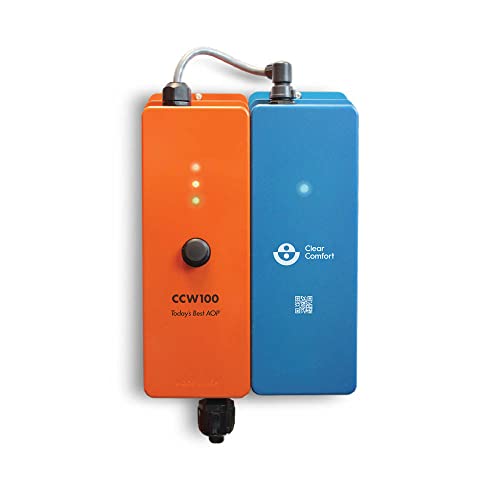
The Clear Comfort CCW100
 system utilizes the power of hydroxyl radicals from combining UV light and oxygen through a patented process. This system is advertised to be suitable for pools up to 40,000 gallons and was listed in 2017 in multiple trade magazines as being one of the best new products in the pool and spa industry.
If you look at e-coli, which is something that most people are familiar with, and how long it takes to kill 99.9% of e-coli you can really see how hydroxyl radicals work more effectively than UV light or ozone alone. In fact, hydroxyl radicals made from oxygen and UV light are vastly superior at eradicating e-coli than either UV or ozone by themselves. Comparatively, it takes 18 times less UV and four times less ozone to kill the same 99.9% of e-coli rather than if either one of these systems is operating independently. This is a clear advantage for hydroxyl radical based disinfection systems, and not a small one, as the chemical oxidation rate for hydroxyl radicals can be between 200 and 1,000,000 times faster than ozone.
Limitations Of AOP In Water Treatment
 AOP and hydroxyl radicals have their limitations and drawbacks for maintaining swimming pool water. Despite the high oxidizing potential of hydroxyl radicals they also suffer from the same drawback that other oxidizers do - they lack the ability to hold a residual value in the water. This is where chlorine shines and the most specific reason as to why you should still use a chemical sanitizer like bromine or chlorine in your pool and spa water. The chemical residual of spent hydroxyl radicals is hydrogen peroxide. This helps to oxidize the pool water but does not hold a residual value for long as it will eventually decompose into dissolved oxygen.
Manufacturers of some hydroxyl radical based UV and ozone disinfection systems boast about the effectiveness of their products being so good that no chlorine at all is needed to keep the pool clear and safe. I respectfully disagree. The technology of hydroxyl radicals is fantastic, and likely to be something we see a lot more of in the future for pools and spas, the reality is that without the ability to hold a sustained residual value in the water there will always be room for contamination. The most effective application of hydroxyl radicals in my opinion would be to use them as a secondary form of water treatment, being sure to maintain at least 1ppm of free chlorine in the water at all times. This need to still have chlorine is the main reason that some pool chemistry minimalists prefer to avoid ozone, UV or AOP systems since you still need to maintain and balance the chlorine no matter what - so what is the point in spending extra money on these supplemental systems?
I have previously written about the risks of chlorine free swimming pools and the dangers associated with swimming in (and even just being near) poorly treated pool and spa water - especially water that lacks a chemical sanitizer. I still believe that chlorine, at least in minimal doses, is still the lesser of two evils when it comes to keeping pool water safe. I do however think that when we solve the problem of chemical sanitizers being required it will most likely involve some form of advanced oxidation process system.
Silver & Hydrogen Peroxide - Hydrogen peroxide, a residual chemical from hydroxyl radical oxidation, is also an unstable oxidizer with a short life span in water (as compared to chlorine). However the addition of silver to hydrogen peroxide creates silver stabilized hydrogen peroxide. This combination produces a faster and more effective oxidation process of bacteria as well as increasing the residual value for the hydrogen peroxide. Silver does not kill bacteria like hydrogen peroxide, instead preventing the bacteria from multiplying. Additionally, hydrogen peroxide is reactive with the protein Catalase which is emitted by bacteria. Normally this would consume much of the oxidizing potential of the hydrogen peroxide. Silver on the other hand is not reactive to these proteins, and when combined with hydrogen peroxide, work in tandem to more easily kill the bacteria. The silver reacts with the protein and destroys it and the hydrogen peroxide oxidizes and destroys the bacteria. The limitation of oxidizers for use as a primary line of protection in water has always been the residual value, or lack thereof. There is no question that oxidizers have the ability to kill bacteria and oxidize organic debris as well or better than chlorine, but the lack of ability to build and hold a residual value in the water is the main problem with these water treatment solutions. While there may be research that suggests silver may help the effectiveness of hydrogen peroxide, this is actually a system that is already in place for swimming pool water management.
Baquacil, or PHMB (polyhexamethylene biguanide) is a stabilized hydrogen peroxide system that is already widely developed and used for swimming pool water quality management. The 27% hydrogen peroxide solution is stabilized with citric acid to help the oxidizer to hold a residual value and resist degradation in the water. While effective, PHMB is not approved as a stand alone solution for any commercial pools in the USA and Canada. This is a fairly clear indicator that PHMB is not the silver bullet to pool and water care though if you are exploring hydrogen peroxide based systems then clearly PHMB is where you should start with your research.
Hydrogen Peroxide & Hydroxyl Radicals
 Water, as most people know, has the chemical composition of H2O - A molecule that consists of two hydrogen and one oxygen atoms (HOH). Hydrogen peroxide is similar, with a chemical composition of two hydrogen atoms and two oxygen atoms (HOHO). Hydroxyl radicals (HO.) can be made from hydrogen peroxide through photolysis. In swimming pool applications it is more efficient (and common) to use ozone (O3) diffused into water (H2O) and photolyze this with germicidal UV light wavelength 254. The resulting reaction creates hydroxyl radicals (·OH).
Oxidation with ozone happens slowly by comparison to oxidation from the highly reactive hydroxyl radicals. This increases the efficiency at which bacteria and organic debris will be oxidized, vastly, and removes one of the biggest limitations with swimming pool ozone systems - contact time with the water. Hydroxyl radicals effectively oxidize contaminants in the water, quickly, before reverting to hydrogen peroxide, and eventually to simply water and oxygen.
The unlocked potential of hydroxyl radical based pool water care certainly opens the door to alternative water chemistry management in pools moving forward. As of current, the most reliably safe method for pool water care is through use of chlorine (or bromine) chemical sanitizer. AOP systems show tremendous promise for enhanced bacteria and organic debris control in swimming pool water, however the system will still likely need to be supplemental to chlorine based sanitizers at least until a reliable and safe residual chemical can be established. Quite possibly the pool water systems of the future will require blended technology such as with ozone systems, UV lights, AOP, silver and stabilized hydrogen peroxide. Since the average pool owner still struggles with the comparatively simple chlorine management system commonly in use today this poses some serious concern for these more advanced systems. The relationship between ozone output, UV light wavelength, hydroxyl radical generation, water turbidity, water pH and total alkalinity is certainly more involved than simply keeping your pH between 7.2 and 7.8 and not letting your free chlorine fall to zero. If moves towards chlorine free systems are in the future for the pool and spa industry then these systems will require either educated, professional water maintenance, or a decided investment from pool owners into understanding and managing their water chemistry variables.
Top content from www.SwimmingPoolSteve.com
Pool and spa chemistry crash course
New pool owner guide
The Swimming Pool Steve blog
Have a question - ask Steve

Swimming Pool Steve is an award winning, second generation swimming pool specialist from Ontario Canada and one of the most trusted voices in the swimming pool industry. With over 20,000,000 views on the Swimming Pool Steve YouTube Channel, winner of the Pleatco Pool & Spa Industry Leadership award and author of hundreds of pool and spa articles both online and in print. Steve is committed to helping pool and spa owners as well as pool and spa industry workers learn more about the technical side of building, renovating, repairing and maintaining all types of swimming pools and spas. Follow Swimming Pool Steve on Facebook, Twitter and YouTube.
Paid PDF Books From Swimming Pool Steve
 Steve's Pool Survival Guide
The Swimming Pool Steve Pool Survival Guide is intended to help pool owners understand their pool and pool equipment better, understand water chemistry, water testing and chemical corrections to the water, troubleshoot the most common pool problems and have confidence in interacting and caring for their pool in the fastest possible frame of time. Also covers pool safety, things to avoid and how to operate your pool more efficiently.
 Salt Water Recommendations
Are you considering upgrading to salt water in your pool? In this paid PDF Steve talks about which pools should avoid using salt water. Find out concerns about using salt in your pool but also the potential benefits of salt water. Finally hear which specific brand and model of salt chlorine generator Steve thinks is the best option currently available to pool owners and how to choose the right size salt system for your pool.
 New Pool Heater Buyer's Guide
In this guide Swimming Pool Steve will help you to better understand your heater options as well as which would be best suited for your pool. Learn about BTU output and sizing of both gas/propane heaters as well as electric heat pumps for residential swimming pools. You will also learn about which specific brands and models of currently available pool heaters Steve likes to recommend. If you are thinking of adding a new pool heater to your equipment pad this buyer's guide would be a useful resource to help you make a more informed buying decision.
 New Pool Installation Value Guide
This is a value shopping guide written by Swimming Pool Steve to help home owners hiring for a new pool installation to get the maximum value for their investment with tips about how to protect your interests during the vetting, hiring and pool installation process. Anyone serious about having a pool installed will find value in this guide. Pool installers will sell the pool package that is best for them - not for you! Become an informed value shopper with this PDF guide.
Endorsed Brands From Swimming Pool Steve
The following links and products are to affiliates of the Swimming Pool Steve website. These are brands, products and services hand selected by Steve for endorsement. Please note that these endorsements can include monetary compensation, affiliate links and referral fees to Swimming Pool Steve, however there is zero additional cost to you should you use one of these products or services. Income generated from these links helps to keep this pool and spa resource available for everyone. To have your product or service considered for listing here as an endorsed brand email SwimmingPoolSteve@gmail.com.
Amazon Disclosure Statement - As an Amazon Associate I earn from qualifying purchases.

www.PoolPartsToGo.com
New Black + Decker variable speed pumps are available online from www.PoolPartsToGo.com and they are a drop in replacement for many popular pump models including Pentair Superflo and Hayward Super Pumps. With an adjustable platform base, union connections included and a very strong warranty these pumps offer an impressive value to pool owners.
- Swimming Pool Steve