
Swimming Pool Fact VS. Myth
SwimmingPoolSteve.com is user-supported. In order to keep this resource about pools and spas available for free to all readers I earn commissions for purchases made through links on this page. For more information see the full disclaimer page. By using this website you are agreeing to the terms and conditions.
As a swimming pool veteran I have heard just about every swimming pool myth you can image - and most of them are just that...myth. Consider some of these common
misconceptions about swimming pools (and one shockingly true myth!):
MORE POWERFUL PUMPS!
 Unless you are Tim The Toolman, or possibly named Cleetus, shopping by horsepower for a new pool pump is a fool's errand. Horsepower is just energy, specifically
745.7 Watts of power per HP. So effectively the HP rating for a pump is simply an indication of how much it will cost to run the pump. So if you have one pump that
is 1 HP and moves 30 gallons per minute of water, and you have a second pump that is a million horsepower and also moves 30 gallons per minute of water...which
is better? The one that cost less to run obviously! Pool pump manufacturers know that pool owners shop by horsepower rating so they play with the service factor
rating to make the HP rating label appear really impressive. If you want to actually get what you pay for with a pool pump then you had better learn to shop according to flow rates.
Unless you are Tim The Toolman, or possibly named Cleetus, shopping by horsepower for a new pool pump is a fool's errand. Horsepower is just energy, specifically
745.7 Watts of power per HP. So effectively the HP rating for a pump is simply an indication of how much it will cost to run the pump. So if you have one pump that
is 1 HP and moves 30 gallons per minute of water, and you have a second pump that is a million horsepower and also moves 30 gallons per minute of water...which
is better? The one that cost less to run obviously! Pool pump manufacturers know that pool owners shop by horsepower rating so they play with the service factor
rating to make the HP rating label appear really impressive. If you want to actually get what you pay for with a pool pump then you had better learn to shop according to flow rates.
Shopping according to flow rates that a pump can provide under specific conditions, such as resistance to flow (called head) is the best way to level the playing
field and choose a pump that will meet your flow requirements while costing as little as possible to operate. If anything, the horsepower rating on a pump should be a
clear signal of which pumps to avoid since the higher the number, the more the pump costs to operate. Leave the rocket powered, nitrous boosted pool pump to Tim and
buy yourself the smallest HP pump you can find that will meet your flow needs.

"I Am Allergic To Chlorine"
 Maybe, but probably not. This is something that pool technicians and water labs hear on a daily basis from customers. If the clients in a pool store were a good
market sample then half of the population of North America would be allergic to chlorine. While it is possible that you are allergic to chlorine, as some people
actually are, the vast majority of people with this complaint are:
Maybe, but probably not. This is something that pool technicians and water labs hear on a daily basis from customers. If the clients in a pool store were a good
market sample then half of the population of North America would be allergic to chlorine. While it is possible that you are allergic to chlorine, as some people
actually are, the vast majority of people with this complaint are:
A) Sensitive to pH levels
B) Not balancing their pool properly
Municipal water sources across North America are treated with chlorine and water arriving in your home very likely has a measurable chlorine level. Can you drink
water from your tap? Are you able to take a bath or shower in your house? If so - you are very likely not allergic to chlorine. People who switch to bromine
or salt water to get away from chlorine exhibit a fundamental misunderstanding of chlorine sanitizer. Salt water is chlorine, and
bromine will not solve your problem if you are in fact simply sensitive to imbalance in the acidity of the water. Remember, bears are attracted to people who are
allergic to chlorine so always think twice before making this claim...there may be a bear within earshot!
Chemicals For A Pool That Changes Color When You Pee
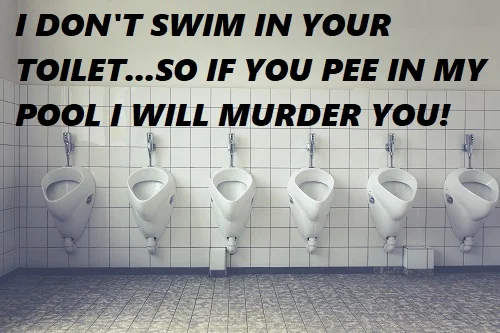 This is true, but in a more accurate way, completely not true. This is one of the largest swimming pool myths but one where the origin is no secret. No self
respecting pool owner wants people relieving themselves in your pool since, you know...that is super disguto. In order to prevent this crime against nature a vicious
lie was made up by pool owners everywhere claiming that if you pee in the water then the water will change color and everyone will laugh and nobody will like you.
This is true, but in a more accurate way, completely not true. This is one of the largest swimming pool myths but one where the origin is no secret. No self
respecting pool owner wants people relieving themselves in your pool since, you know...that is super disguto. In order to prevent this crime against nature a vicious
lie was made up by pool owners everywhere claiming that if you pee in the water then the water will change color and everyone will laugh and nobody will like you.
The truth is that there is no such chemical, and you are safe to be as disgusting as you like in someone's pool. Other than increasing the chlorine demand, as well as
the amount of chloramines in the water (which make the chlorine smell), there is no chemical reaction that will happen that will show anyone what you are doing.
Releasing some air bubbles by accident might give you away however...
In addition to there not actually being a chemical that can do this currently, there is not likely a chemical to become available any time soon with these properties.
The technical challenge associated with changing the color of pool water when you pee are too great - men on the moon...no problem. Pee indicator? Never going to
happen.
Test Strips For Testing Pool Water
 Are test strips for pool water super convenient - yes. Are they great at testing water chemistry - no, not really. Actually, it depends on what you are testing for. Pool water test strips
In addition to being not-so-great at determining pH, test strips also rely on the ability of the user to judge color differences - especially in the yellow and red
spectrums. Since not every person has the same level of color differentiation this can lead to misinterpretation of the test results. When in doubt simply ask a
woman since women can see
differences in colors better than men. Also worth mentioning is that is it not possible to "test" pool water by just looking at it. A DPD test is the best method
for testing at home and test strips are a good quick check method. If you rely on sight to balance your pool water you can rest assured that you are not doing it
correctly.
Pool Guys Are Crooks
 There are a few industries that have a strong negative connotation associated with them such as used car salesmen - swimming pool builders fit squarely into that
category. The reason why is multiple-fold. First, in most areas in North America, even up to today, there is no licensing, testing, trade association or government
requirements for who can (and who can not) be a pool builder.
There are a few industries that have a strong negative connotation associated with them such as used car salesmen - swimming pool builders fit squarely into that
category. The reason why is multiple-fold. First, in most areas in North America, even up to today, there is no licensing, testing, trade association or government
requirements for who can (and who can not) be a pool builder.
Unlike other more regulated trades such as auto mechanics, or electricians, you generally do not require any special training or minimum skill set in order to be
considered a "pool builder". This has resulted in an industry-wide lack of congruency in terms of technical process. Each pool company develops an in-house method
for building pools. This makes the industry as a whole very volatile as you never know what the last guy who worked on the pool did - which results in very difficult
to plan for situations. Combine this with the fact that building a swimming pool is actually a fairly technical process involving multiple trades such as masonry,
forming and framing, plumbing, electrical, steel working and design - also combined with chemistry for water balancing. Most cases where pool guys are thought to be
scam artists, they are actually just under qualified, or simply not qualified, for the work that you are paying them to do. Just like with other trades there are
workers who have the bare minimum level of knowledge and there are those that dedicate to learning as much as they can about the industry that they operate in - if you
meet with a prospective pool builder that you would not trust to wash your car properly then you should probably keep interviewing more builders!
Chlorine Is Bad For Your Health
 Looking for an alternative to chlorine? How about being dead? There is a very good reason why chemical sanitizers are used in swimming pools and hot tubs. While
chemicals are certainly not good for you in many cases and it is very understandable that you would want to limit your exposure to harmful chemicals, it is important
to recognize that for the most part chlorine is not one of those. While chlorine is a harsh chemical, and in concentrated doses can be lethal, it is also safe enough
to drink...literally. This is why chlorine (and more recently chloramines) are the sanitizer of choice for municipal drinking water. In monitored levels it can
provide a fair margin of safety over untreated water which is something that you absolutely want.
Looking for an alternative to chlorine? How about being dead? There is a very good reason why chemical sanitizers are used in swimming pools and hot tubs. While
chemicals are certainly not good for you in many cases and it is very understandable that you would want to limit your exposure to harmful chemicals, it is important
to recognize that for the most part chlorine is not one of those. While chlorine is a harsh chemical, and in concentrated doses can be lethal, it is also safe enough
to drink...literally. This is why chlorine (and more recently chloramines) are the sanitizer of choice for municipal drinking water. In monitored levels it can
provide a fair margin of safety over untreated water which is something that you absolutely want.
In February 1999 in Bovenkarspel Netherlands there was a home show / fair exhibition that included a hot tub that was set up on display for 9 days. At the conclusion
of the nine days (following the in-depth investigation) that hot tub was responsible for 319 confirmed cases of Legionnaires disease and the deaths of 32 people (more
deaths were suspected but not able to be proven). It is important to note that in this case the people to get sick did not actually use the hot tub - Legionnaires
disease is airborne and the majority of people who fell ill either touched the water with their hands or simply walked by its location!. Chlorine sanitizer
plays an incredibly important part in safe swimming water. Using things like a UV system or an ozone generator can reduce your need
for chlorine but you should still have at minimum 1 ppm of free chlorine in your water at all times. Even 1 ppm of chlorine is not enough to say that the water is
"safe" but the vast majority of dangerous bacteria and pathogens will be killed at this level.
Top content from www.SwimmingPoolSteve.com
Pool and spa chemistry crash course
New pool owner guide
The Swimming Pool Steve blog
Have a question - ask Steve

Swimming Pool Steve is an award winning, second generation swimming pool specialist from Ontario Canada and one of the most trusted voices in the swimming pool industry. With over 20,000,000 views on the Swimming Pool Steve YouTube Channel, winner of the Pleatco Pool & Spa Industry Leadership award and author of hundreds of pool and spa articles both online and in print. Steve is committed to helping pool and spa owners as well as pool and spa industry workers learn more about the technical side of building, renovating, repairing and maintaining all types of swimming pools and spas. Follow Swimming Pool Steve on Facebook, Twitter and YouTube.
Paid PDF Books From Swimming Pool Steve
 Steve's Pool Survival Guide
The Swimming Pool Steve Pool Survival Guide is intended to help pool owners understand their pool and pool equipment better, understand water chemistry, water testing and chemical corrections to the water, troubleshoot the most common pool problems and have confidence in interacting and caring for their pool in the fastest possible frame of time. Also covers pool safety, things to avoid and how to operate your pool more efficiently.
 Salt Water Recommendations
Are you considering upgrading to salt water in your pool? In this paid PDF Steve talks about which pools should avoid using salt water. Find out concerns about using salt in your pool but also the potential benefits of salt water. Finally hear which specific brand and model of salt chlorine generator Steve thinks is the best option currently available to pool owners and how to choose the right size salt system for your pool.
 New Pool Heater Buyer's Guide
In this guide Swimming Pool Steve will help you to better understand your heater options as well as which would be best suited for your pool. Learn about BTU output and sizing of both gas/propane heaters as well as electric heat pumps for residential swimming pools. You will also learn about which specific brands and models of currently available pool heaters Steve likes to recommend. If you are thinking of adding a new pool heater to your equipment pad this buyer's guide would be a useful resource to help you make a more informed buying decision.
 New Pool Installation Value Guide
This is a value shopping guide written by Swimming Pool Steve to help home owners hiring for a new pool installation to get the maximum value for their investment with tips about how to protect your interests during the vetting, hiring and pool installation process. Anyone serious about having a pool installed will find value in this guide. Pool installers will sell the pool package that is best for them - not for you! Become an informed value shopper with this PDF guide.
Endorsed Brands From Swimming Pool Steve
The following links and products are to affiliates of the Swimming Pool Steve website. These are brands, products and services hand selected by Steve for endorsement. Please note that these endorsements can include monetary compensation, affiliate links and referral fees to Swimming Pool Steve, however there is zero additional cost to you should you use one of these products or services. Income generated from these links helps to keep this pool and spa resource available for everyone. To have your product or service considered for listing here as an endorsed brand email SwimmingPoolSteve@gmail.com.
Amazon Disclosure Statement - As an Amazon Associate I earn from qualifying purchases.

www.PoolPartsToGo.com
New Black + Decker variable speed pumps are available online from www.PoolPartsToGo.com and they are a drop in replacement for many popular pump models including Pentair Superflo and Hayward Super Pumps. With an adjustable platform base, union connections included and a very strong warranty these pumps offer an impressive value to pool owners.
- Swimming Pool Steve