Hidden Dangers In Swimming Pools
SwimmingPoolSteve.com is user-supported. In order to keep this resource about pools and spas available for free to all readers I earn commissions for purchases made through links on this page. For more information see the full disclaimer page. By using this website you are agreeing to the terms and conditions.
 For many people the question of safety and swimming pools will be the number one concern when considering installing a pool or buying a house with a pool. On average over 3500 people per year drown in the USA and approximately half of those happen in swimming pools. That is the equivalent of almost five people per day, every day of the year, who drown in swimming pools. A swimming pool is a huge responsibility and one that you must strive to make safe, or as safe as possible, to reduce the potential for an accident in your pool. Supposing that you want to make your pool area as safe as possible...how exactly do you do that? What are the major areas of concern and what can you do to lessen the likelihood of an accident or drowning in your pool? Quite a bit.
First, this article on essential pool safety equipment would be a good place to start. Every pool should have minimum life saving equipment on hand, readily accessible, at all times. Review that article to make sure that you have everything that you should have in terms of safety equipment.
Restrict Access To Your Pool - Every pool owner needs to accept that their pool is potentially dangerous and treat it as such. Swimming pools must be able to have access to them restricted, usually with a fence that includes a self closing and self latching gate. Almost all areas in Canada and the USA have local bylaw codes for fences that limit access to the pool area. These fences need to be of a minimum height as well as consist of a non-climbable construction. Check with your local code office to find out what the minimum requirements are in your area. In addition to fencing and gating your property you may also want to consider adding a pool safety fence around the pool deck itself which provides another barrier to prevent unwanted access to the pool.

Wires Over Swimming Pools
 Who would put a swimming pool underneath live wires of any kind? Unfortunately, lots of people. In modern day construction you would not be approved to install a pool under service wiring of any kind...if you get a permit. There are a lot of pools that get installed every year where permits are not taken and proper site inspections not made. This is a concern but much less so than older pools which were built during a time when rules were more relaxed. There are many pools in operation today where wires run over top or adjacent to the pool area. The problem is that in many of these cases there is no other option for running the wires...the pool should never have been installed to begin with. Who wants to give up their swimming pool, at great expense, due to a "problem" that has been there since the pool was installed? Not many people I would imagine, but as a pool and spa expert, and someone with formal and practical training with electricity, you would NEVER find myself or someone I know swimming in a pool that has overhead wires of any kind. Zero chance.
The picture above is one I took while traveling. This is a hotel pool and as you can see from the reflection in the water there are electrical transmission lines installed directly next to, and alongside, the pool. Despite the staggering heat I did not go into this pool due to the proximity of these wires (not to mention the turbidity in the water).
Medium Voltage Lines - Despite how the name sounds these are powerful, long range lines that are typically found higher up on service poles. These service lines carry anywhere from 750 volts up to 35,000 volts. Why is so high of a voltage used you might wonder - current and voltage are inversely proportional according to electrical theory. This means that if the voltage goes up in a circuit then the amperage (current) goes down. Heat losses in electrical transmission is a major concern, as is voltage drop over long distances. By increasing the voltage the current decreases. Power in a system is equal to the squared current times the resistance of the system. By reducing current (by increasing voltage) you reduce the heat generated and system losses to heat. With higher initial voltages, the voltage drop over long distances is minimal versus a system with a lower voltage and higher current.
Low Voltage Lines - Not to be confused with LV, or low voltage residential systems (like 12 volt lights) low voltage service lines are anything under 750 volts. Most commonly these service lines will be found at 120 volts and 240 volts which is what the average house system uses in North America. Again, contrary to how they sound, low voltage service lines are very powerful, high amperage lines, and are extremely dangerous.
Telecom & Cable Lines - The lowest wires on service poles, and the most likely to be encroaching on your swimming pool area are telecom, phone, internet and cable wires. These lines can carry up to 50 to 60 volts and also pose a risk to swimmers when directly overhead the pool.
 So how far away should all of these wires be from your pool? That answer will depend on exactly where you live and how strict the codes are for this in your area. In many areas the code requires 5m (16 feet) clearance between wires and ANY part of your pool. This includes things like slides as well which can obviously be closer to overhead wires than the water level in the pool itself. You should never attempt to use any tool or tape measurer around overhead wires. If you want to know how close your wires are to your pool then a visual estimate is your best option. The concern is not simply that the wires can fall into the pool, though that certainly is a concern, but also that you potentially could make contact with both the pool water as well as the wires when using items like an aluminum telescoping pole.
If you have wires running anywhere near to the pool area then you should invest in having the wires re-run in a different configuration that provides a wider berth for the pool. The number of times that I have encountered main electrical service wires to a house running directly over a pool is shocking, pun intended, and if your pool has this you need to change it. I, personally, have witnessed main electrical services fall off from a house without warning on two occasions...one of which landed in a hail of fireworks on the ground less than ten feet from where I was standing. You will not convince me that swimming in a pool with an overhead electrical service is OK. If you have this then I strongly encourage you to close the pool completely until this can be resolved.
12 volt light strings over pools - Adding a string of 12 volt lights over your pool may sound like an awesome way to increase the ambiance of your pool area, but the risk is simply not worth the reward. First, any electrical in or around the pool would need to be protected with a GFI circuit, but even still, lights over your pool is a bad idea. If the GFI is not installed correctly, or has failed, or there is a break in the ground wire, it is possible that the GFI will not function as intended. Also most lights do not use a step down transformer that meets current pool and spa requirements. Any lighting used in or around a pool needs to be used with a pool and spa specific transformer which has isolated primary and secondary coils. While 12 volt systems sound much less insidious than 120 volt systems, and to an extent they are, you must be aware that a 12 volt system can still kill you. Current is what kills people, not voltage, and only 0.01 Amps is enough to stop your heart. 12 volt or 120 volt can both be lethal, so do not think that 12 volt lights hanging over your pool are any safer than 120 volt lights. Both are dangerous and both should not be there.
Buried Wires - Buried wires near to the pool area are also a concern however these are usually harder to spot. If you suspect that you have electrical service lines running underground near your pool then contact the local electrical authority to come out and locate the electrical service on your property just to be sure.
Electric & Bonding Grid Deficiencies
 Electricity and water do not mix. The concern for overhead wires is only one of many electrical concerns when it comes to swimming pool safety. One of the largest concerns with swimming pools and electricity has to do with bonding and grounding of the pool and pool system. Bonding is the process of connecting all metal components in and around a pool together so that they all have the same electrical potential. Grounding is the process of making sure that the bonding grid is directly tied to the lowest possible electrical potential, or ground. Together these work to protect swimmers against shock and electrocution. Unfortunately there are many pools in operation today where the bonding and grounding systems were not installed correctly, or have become damaged or deficient in some way over time.
Lack Of Bonding - Without a functional bonding grid it is possible that the pool, or any two components within the pool system, can have a potential difference in energy which is otherwise known as voltage. If two items have a different electrical voltage, and something connects the two together, there will be a sudden balancing between the two systems via the intermediary connection. If a person is the intermediary between two differing electrical potentials this results in an electric shock.
Lack Of Grounding - If an electrical system lacks a proper ground then a voltage can exist isolated from ground. This means that a pool that is bonded will all have the same electrical potential, but this could be zero, 120 volts or 10,000 volts in theory. The ground reference is what prevents your pool system from developing a "floating ground" where the pool has no electrical potential in relation to itself, but an elevated electrical potential compared to anything around it.
Unless you are an electrician or have advanced electrical understanding you should not attempt to diagnose the existence of the bonding and grounding of your pool yourself. As a pool owner the best you can do is visually inspect your pool equipment for bonding and grounding wires as well as hire an electrical professional to inspect and test your pool bonding and grounding for you. The biggest and most apparent sign that you should be aware of is if anyone gets a shock from any part of your pool. No matter how small or harmless feeling the shock might feel, any shock indicates a failure in the bonding or grounding system and the pool should absolutely be closed to swimmers until the source of the electric fault can be found and the repair can be made. No amount of shock is acceptable around a swimming pool.
GFI Protection - A GFI, or ground fault interrupter, detects the presence of current in the ground conductor of a circuit (where it should never be except during an electrical fault) and disconnects the power to this circuit. Every electrically powered device in or around your pool should be operated on a GFI protected circuit. Since GFI breakers and circuits are much more expensive than non-GFI breakers, and they can sometimes have intermittent problems where the breaker trips, often pool equipment is installed without GFI protection. Pool pumps in particular can sometimes trip out sensitive GFI breakers however all pumps should be protected with GFI breakers regardless. The close contact of water and electricity with your pool pump demands that you use a GFI, as does the National Electrical Code so make sure that all of your electrical equipment is up to code.
Improper Wires & Connectors - According to the National Electrical Code any wiring that is to be installed outdoors or in potentially damp locations should be done so with approved weatherproof conduits and "wet connect" box connectors. The cost of water and weather proof electrical supplies are easily ten times as much as similar, non-weather and water rated electrical supplies. For this reason, and for a general lack of understanding of code requirements, most swimming pool electrical systems are not installed correctly. The instances of indoor wiring like romex or BX cable, non-water rated L-16 box connectors, non-weather proof termination boxes and other electrical infractions far outnumber the pools which are wired safely and correctly. It is very likely that if you have a pool that your wiring, boxes, connectors and breakers are not done correctly. There is no price for safety so bringing all electrical up to waterproof and weather resistant code should simply be viewed as the cost of owning a swimming pool.
Entrapment Hazards In Pools

Entrapment hazards in swimming pools are a very large concern. Plumbing suction points, when configured incorrectly, can result in swimmers becoming trapped underwater or have parts of their bodies sucked into the plumbing system. The amount of power that exists in a swimming pool pump is incredible. All of this power is transferred into suction, and since a plumbing system is closed loop this means that anything that blocks off the suction ports will become stuck there.
Modern day swimming pools are built with entrapment avoidance in mind. Suction systems are carefully designed and installed, using compliant anti-entrapment materials and installation standards. This definitely reduces the instances of pool entrapment drownings and injuries, however it does not eliminate them. First, there are many, many pools in operation today which do not meet current standards for anti entrapment. These pools are considered to be "grandfathered" in that they were built during a time where these codes adherences were not required. Since, in most cases, fixing these problems requires significant renovations to the pool, the pool is allowed to exist as-is until such time as a major renovation is completed on the pool. At this time it is expected that the pool will be brought up to current standards.
What this means to pool owners, and especially those buying a house with an older existing pool, is that your pool may not meet current safety standards. It is up to you, the owner of the pool, to notice if your pool has an entrapment hazard. There are quite a few ways that your pool might not meet current day safety standards.
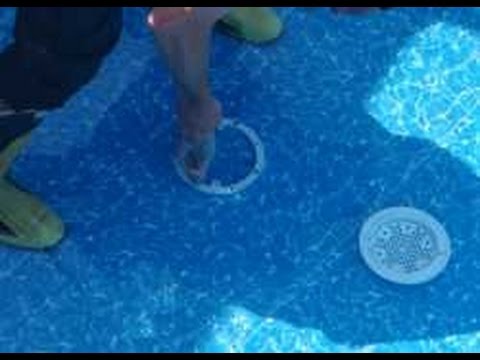
 . These systems will detect a block in the suction line, should one happen, and turn off the pump to prevent the potential for trapping and drowning a swimmer in the pool.

 which prevents the port from being opened while the system in under suction pressure. The hidden danger for some swimming pools is that these suction ports are often mistaken for just another pool return by new pool owners, or novice pool technicians during the busy opening season. You should double check all of your pool returns to make sure that they all have pressure. If any of your pool returns have suction instead of pressure then you need to replace the regular fitting that someone put in with one of these vacuum lock fittings.
 If you were to go back in time 30 or 40 years what you would find is that almost every swimming pool deck was made from the same plain broomed concrete. The reason why broomed concrete has always been used around swimming pools is due to the high level of traction the broomed texture provides. Best of intentions aside, people do run on pool decks, and pool decks are often covered with water. Modern day swimming pools have a much greater chance for slip and fall accidents as a result of stamped and decorative concrete becoming more common for pool decks.