
How Much Chlorine Should I Add To My Pool?
SwimmingPoolSteve.com is user-supported. In order to keep this resource about pools and spas available for free to all readers I earn commissions for purchases made through links on this page. For more information see the full disclaimer page. By using this website you are agreeing to the terms and conditions.
How much chlorine should I add to my pool is a straight forwarding sounding question that is the source of a lot of frustration to new pool owners. Despite how you might ask about how much chlorine to put in your pool you will only find vague answers relating to residual values of free chlorine that you need to establish. The reason why this is such a difficult question to answer, for one, is there are many different kinds (and strengths) of concrete products for swimming pools. More importantly than that however is the fact that chlorine residual is easy to calculate for a given volume of water...once you have established at least some residual value of chlorine already. If you have zero chlorine in your water then you need to understand you don't have zero, you actually have some unknown negative value number.
It is this unknown negative value in your water that is the source of you not getting a straight forward answer about how much chlorine you should add to your pool. I can tell you how to figure out one part per million of chlorine in a given volume of water, of five or ten parts per million, but so long as you are currently showing zero for your chlorine level then it is not possible to know what the final number will be for the chlorine you need. At absolute best there has to be at least a few steps in this process in order to answer your question about how much chlorine you need to add to your pool. The first part of this process is understanding that you will need to keep adding chlorine until such time as you can see a residual value, above zero, when you test. Once you reach this point answering your question about how much chlorine to add gets easy so let's hurry up and get you to that point.

Building a residual chlorine value
When you have zero chlorine in your water you actually have an unknown quantity of bacteria and organic debris in the water. There is no way for anyone to know how much bacteria and organic debris is currently residing in your water. Since the target range for your chlorine is 2 to 4 parts per million ideally, and you currently have zero, then perhaps a good starting point is to start dosing your pool in 5 ppm increments of chlorine.
If you had zero chlorine but no buildup of organic debris then adding 5 ppm worth of chlorine would net you 5 ppm of free chlorine. If you come up a little short of that value then you still end up square in the ideal range that you are looking for. By adding chlorine in 5 ppm increments you should be able to overcome any amount of residual bacteria and algae with only a few treatments in most cases. Just be sure to leave at least eight hours in between chlorine doses to give the chemicals time to react with your water. Pools are huge and it takes time for the chemical reactions to fully happen.
Add chlorine in 5 ppm increments to your pool with eight hours minimum in between doses
You do not just want to add 15 ppm of chlorine or more of chlorine to your pool in most cases. It would certainly not be ideal to accidentally end up with 13, 14 or 15 ppm of free chlorine in your pool as this is far too much. This is why you would not just want to drop a chlorine bomb into your pool and end up way over the ideal range. You could damage parts of the pool in a worst case scenario like your pool heater, or interior surfaces like vinyl liners. These examples would take quite a miss with the chlorine treatment but at the very least you could end up unable to swim, which is where you are right now with no chlorine at all in the water.
Increasing Chlorine Levels In Pool Water
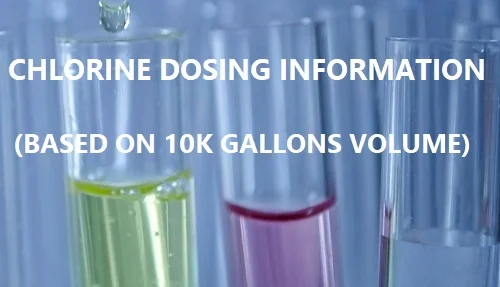
Now that we are all on the same page with how chlorine dosing works to get you over that initial unknown quantity of bacteria and organic debris in the water we can look at how much chlorine you should be adding per dose. Working with the idea of 5 ppm increments you also need to know the volume of your pool to begin the calculations. I will use a round number value of 10,000 gallons so that it should be an easy number to increase or decrease as needed to apply to your specific pool volume.
So the setup is that the pool we are calculating chlorine values for is 10,000 gallons (40,000 liters) and we want to add 5 ppm of chlorine to see if this is enough to establish a chlorine residual. If not we are going to wait eight hours and then try again with the same dose. Keep repeating this process up to three times every day until you finally overcome the bacterial and organic debris load in the water. So what type of chlorine do you use? There are a lot of different kinds of chlorine and they all have different strength concentrations that you need to consider.
Liquid bleach (5.25% concentration) - 4.0 Quarts (3.79 Liters) for 5 ppm in 10,000 gallons
Liquid chlorine (12% concentration) - 1.7 Quarts (1.36 Liters) for 5 ppm in 10,000 gallons
Cal-hypo (67% concentration) - 10 Ounces (315 Grams) for 5 ppm in 10,000 gallons
Dichlor (62% concentration) - 10.75 Ounces (320 Grams) for 5 ppm in 10,000 gallons
Trichlor (90% concentration) - 7.5 Ounces (220 Grams) for 5 ppm in 10,000 gallons
With these numbers you can begin the process of dosing your pool to raise your chlorine levels. Just be sure that the rest of your pool chemistry variables are in the correct ranges. For example a lack of CYA in the water (30 to 50 ppm ideal value) you will not be able to hold a chlorine residual no matter how much you add to the water. Each day without the protection of the cyanuric acid the UV will degrade any chlorine that would normally be held as a residual in your water. It is also worth noting that it can happen that you have so much chlorine that is gives somewhat of a false negative on some chlorine tests. If your chlorine levels were high enough they could actually be bleaching the test strips or colormetric reagents you are using. Be on the lookout for test strips that burn around the outer edges, turn a dark color and then revert quickly to white, as well as dropper tests where the drop flashes a bright color and then disappears. If you keep adding more chlorine when you have so much that you actually think you have none this definitely could result in some damage to integral components of your pool.
It is also worth mentioning that many new pool owners do not realize that stabilized chlorine like dichlor and trichlor contains CYA (stabilizer / water conditioner) and every time you add one of these to your water you are increasing the CYA level. At 30 to 50 ppm this helps your chlorine to hold a residual. When you build to 80 or 100+ ppm then your chlorine will be largely unable to work in your pool water despite having a measurable reading. You should be aware of which forms of chlorine you add to your pool and try to avoid chlorine with CYA so you can avoid draining and refilling with fresh water to keep your CYA levels down in the appropriate range.
Pool chemistry crash course
What is pool stabilizer?
Do pools really need chlorine?
Why did my pool water turn green?
Top content from www.SwimmingPoolSteve.com
Pool and spa chemistry crash course
New pool owner guide
The Swimming Pool Steve blog
Have a question - ask Steve

Swimming Pool Steve is an award winning, second generation swimming pool specialist from Ontario Canada and one of the most trusted voices in the swimming pool industry. With over 20,000,000 views on the Swimming Pool Steve YouTube Channel, winner of the Pleatco Pool & Spa Industry Leadership award and author of hundreds of pool and spa articles both online and in print. Steve is committed to helping pool and spa owners as well as pool and spa industry workers learn more about the technical side of building, renovating, repairing and maintaining all types of swimming pools and spas. Follow Swimming Pool Steve on Facebook, Twitter and YouTube.
Paid PDF Books From Swimming Pool Steve
 Steve's Pool Survival Guide
The Swimming Pool Steve Pool Survival Guide is intended to help pool owners understand their pool and pool equipment better, understand water chemistry, water testing and chemical corrections to the water, troubleshoot the most common pool problems and have confidence in interacting and caring for their pool in the fastest possible frame of time. Also covers pool safety, things to avoid and how to operate your pool more efficiently.
 Salt Water Recommendations
Are you considering upgrading to salt water in your pool? In this paid PDF Steve talks about which pools should avoid using salt water. Find out concerns about using salt in your pool but also the potential benefits of salt water. Finally hear which specific brand and model of salt chlorine generator Steve thinks is the best option currently available to pool owners and how to choose the right size salt system for your pool.
 New Pool Heater Buyer's Guide
In this guide Swimming Pool Steve will help you to better understand your heater options as well as which would be best suited for your pool. Learn about BTU output and sizing of both gas/propane heaters as well as electric heat pumps for residential swimming pools. You will also learn about which specific brands and models of currently available pool heaters Steve likes to recommend. If you are thinking of adding a new pool heater to your equipment pad this buyer's guide would be a useful resource to help you make a more informed buying decision.
 New Pool Installation Value Guide
This is a value shopping guide written by Swimming Pool Steve to help home owners hiring for a new pool installation to get the maximum value for their investment with tips about how to protect your interests during the vetting, hiring and pool installation process. Anyone serious about having a pool installed will find value in this guide. Pool installers will sell the pool package that is best for them - not for you! Become an informed value shopper with this PDF guide.
Endorsed Brands From Swimming Pool Steve
The following links and products are to affiliates of the Swimming Pool Steve website. These are brands, products and services hand selected by Steve for endorsement. Please note that these endorsements can include monetary compensation, affiliate links and referral fees to Swimming Pool Steve, however there is zero additional cost to you should you use one of these products or services. Income generated from these links helps to keep this pool and spa resource available for everyone. To have your product or service considered for listing here as an endorsed brand email SwimmingPoolSteve@gmail.com.
Amazon Disclosure Statement - As an Amazon Associate I earn from qualifying purchases.

www.PoolPartsToGo.com
New Black + Decker variable speed pumps are available online from www.PoolPartsToGo.com and they are a drop in replacement for many popular pump models including Pentair Superflo and Hayward Super Pumps. With an adjustable platform base, union connections included and a very strong warranty these pumps offer an impressive value to pool owners.
- Swimming Pool Steve