
Why Is My Chlorine Not Working?
SwimmingPoolSteve.com is user-supported. In order to keep this resource about pools and spas available for free to all readers I earn commissions for purchases made through links on this page. For more information see the full disclaimer page. By using this website you are agreeing to the terms and conditions.

Why is my chlorine not working? If you are a frustrated swimming pool owner trying to figure out why you are having issues with your water quality then this article will help you to understand some of the limitations of chlorine and the reasons why yours might not be working as well as it should. First, you should realize that there are in fact a few different situations that you can find yourself in where you have chlorine but it is just not able to do the job you expect it to do. You can also get into a situation where you keep adding chlorine to the water but it is either gone by the next morning, or just not improving the water like it should.
Water quality, testing and balancing for swimming pools is not rocket science and in the vast majority of cases establishing and maintaining your free chlorine, total alkalinity, pH, calcium hardness and cyanuric acid levels is all you need to do to keep your water clear and well balanced (filtering also). Problems with one of these values is enough to cause green water or cloudy water and most water quality problems will be fixed by checking and adjusting these basic values back into the normal range. However there are also times where these basic water chemistry values will not be enough on their own and you need to look deeper to find the cause for your water quality problems.


High pH levels - Something that pool owners do not appreciate is that the pH of the water has a huge impact on how well your chlorine is able to function. The ideal pH range for chlorine is actually much lower than any level you would ever want to bathe in. The pH that we keep pool water to be comfortable for people, 7.4 to 7.6 is actually on the very upper end of the pH range that chlorine will function in. By the time you hit a pH of 8.0 (which is 10 times more alkaline than a pH of 7.0) the chlorine is almost completely inactive in the water. You can measure the water and you can see a free chlorine level above zero parts per million, however the water is still cloudy or green.
Salt water pools in particular struggle with chronic high pH levels due to the type of chlorine generated by electrolysis cells having a very high pH. If your pH is over 8.0 then this is the reason that your chlorine is not able to function in the water properly. It might be helpful to go back to basics and review the pool and spa water chemistry lesson to make sure you have your order of operations right for your chemical corrections. You can also review this article about salt water pool maintenance to learn more about high pH in salt water pools and what you can do to mitigate this issue.
Pool stabilizer - Pool stabilizer, water conditioner or CYA (cyanuric acid) are all different ways of saying the same thing. Without CYA chlorine is "unstable" which means that it degrades quickly when exposed to UV light, like from the sun. No matter how much chlorine you have in your pool water, without any CYA your chlorine levels would reduce by half every hour that the pool is in the sun. At 30 to 50 ppm CYA provides chlorine protection against the damaging UV rays which help you to maintain a free chlorine residual in your pool at all times. However when the CYA level rises above 80 to 100 ppm you will enter a chlorine lock situation where you have a measurable chlorine level, but it is simply not able to effectively kill bacteria and organic contaminants.
This is one of the most common problems that new pool owners will encounter with their chlorine as many people do not realize that stabilized chlorine, like dichlor and trichlor, have high CYA levels and every time you add one of these to your pool you increase the chlorine level, but you also increase the CYA level. If you let the CYA level rise too much then your chlorine becomes ineffective. In theory you can maintain CYA levels of up to 150 ppm however this would require that you also increase the free chlorine level to be 5% of the CYA value (7.5 in this case) in order to have the chlorine still kill bacteria and organic growth. Most residential pools do not operate at free chlorine levels so high, and so the traditional solution to high CYA applies, which is partial draining and refilling with fresh source water that does not contain cynauric acid. Recently there has been a new enzyme product that might have the ability to reduce CYA levels without the need to drain and fill however the feedback from this product has indicated that it is minimally effective, and most pool technicians and pool owners still rely on partial drain and refilling to keep CYA levels in the 30 to 50 ppm range where they should be. For more information you can read this article on pool stabilizer.
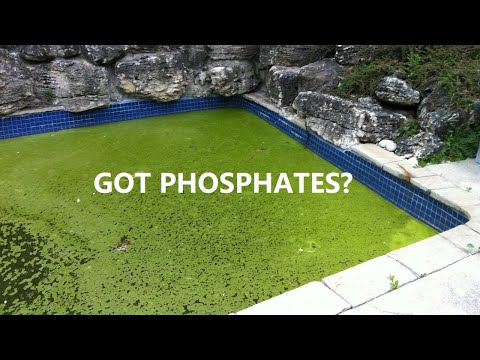
Phosphates are found in soaps and detergents, rural water supplies, farm runoff and fertilizers. We measure phosphates in pools in parts per billion as they are significant in even very tiny quantities. Over 500 ppb you will notice you use more chlorine than you used to, and at 1000 to 2000 ppb you will struggle to keep your pool water clear, and your free chlorine level will be very hard to establish and hold a residual.
Biofilm accumulation - Biofilm is the slimy, sticky gunk that gets stuck to the sides of your pool walls and floor, lives inside your filter, but most especially resides within the plumbing lines for your pool. It is both a food source for bacteria, but also a layer of mechanical protection for bacteria which limits the ability for your chlorine to access and kill it. This biofilm is specifically a problem in swimming pool plumbing because it takes more than chemicals or normal movement of water to fully dislodge and remove it. This is why hot tubs with their hot water bacteria breeding grounds need to have the pipes flushed in between water changes. This pipe flushing process uses a degreasing cleaner which helps to strip biofilms from the inside of your pipes. Pools might not develop as much biofilm as a hot tub will however it is still a problem that can plague certain pools. Since you can not see the inside of your plumbing lines you will probably not see the biofilm directly, but instead the symptom of biofilm which is a difficulty in establishing and holding a residual free chlorine value in the water. A pipe flush is not practical for most pools since you do not actually drain and refill pools very often. In fact with many pool types draining it (or draining it improperly) can result in damage anywhere from minor to major. Since you need to remove the water after pipe flushing this is not an ideal way to handle biofilm accumulation in a swimming pool. Instead if you believe that you have an issue with a persistent biofilm you should consider using a bio film inhibitor product like Aquafinesse. These products help to break down existing biofilm and prevent new biofilm from forming and attaching to the inside of your pipes.
These are the most common chemistry related reasons that you could be experiencing problems with your chlorine and the quality of your pool water. It is definitely worth mentioning that filtration is also very important to the quality of your water and your ability to hold and maintain a free chlorine value. You should be filtering your pool volume three times every 24 hours as the minimum value, which most pool owners do not, as this is a chemical free way to reduce on the contaminants in your water. Every piece of organic debris and bacteria that is physically removed by the filter is one less that your chlorine needs to deal with. If you have leaves floating in your pool or sunken to the pool floor these must be completely removed or you will struggle to maintain your chlorine levels. Skim, brush and vacuum your pool regularly, filter your water volume three times daily, and monitor the chemical levels described above to resolve any problems you have with green water or your chlorine not being effective enough.
Top content from www.SwimmingPoolSteve.com
Pool and spa chemistry crash course
New pool owner guide
The Swimming Pool Steve blog
Have a question - ask Steve

Swimming Pool Steve is an award winning, second generation swimming pool specialist from Ontario Canada and one of the most trusted voices in the swimming pool industry. With over 20,000,000 views on the Swimming Pool Steve YouTube Channel, winner of the Pleatco Pool & Spa Industry Leadership award and author of hundreds of pool and spa articles both online and in print. Steve is committed to helping pool and spa owners as well as pool and spa industry workers learn more about the technical side of building, renovating, repairing and maintaining all types of swimming pools and spas. Follow Swimming Pool Steve on Facebook, Twitter and YouTube.
Paid PDF Books From Swimming Pool Steve
 Steve's Pool Survival Guide
The Swimming Pool Steve Pool Survival Guide is intended to help pool owners understand their pool and pool equipment better, understand water chemistry, water testing and chemical corrections to the water, troubleshoot the most common pool problems and have confidence in interacting and caring for their pool in the fastest possible frame of time. Also covers pool safety, things to avoid and how to operate your pool more efficiently.
 Salt Water Recommendations
Are you considering upgrading to salt water in your pool? In this paid PDF Steve talks about which pools should avoid using salt water. Find out concerns about using salt in your pool but also the potential benefits of salt water. Finally hear which specific brand and model of salt chlorine generator Steve thinks is the best option currently available to pool owners and how to choose the right size salt system for your pool.
 New Pool Heater Buyer's Guide
In this guide Swimming Pool Steve will help you to better understand your heater options as well as which would be best suited for your pool. Learn about BTU output and sizing of both gas/propane heaters as well as electric heat pumps for residential swimming pools. You will also learn about which specific brands and models of currently available pool heaters Steve likes to recommend. If you are thinking of adding a new pool heater to your equipment pad this buyer's guide would be a useful resource to help you make a more informed buying decision.
 New Pool Installation Value Guide
This is a value shopping guide written by Swimming Pool Steve to help home owners hiring for a new pool installation to get the maximum value for their investment with tips about how to protect your interests during the vetting, hiring and pool installation process. Anyone serious about having a pool installed will find value in this guide. Pool installers will sell the pool package that is best for them - not for you! Become an informed value shopper with this PDF guide.
Endorsed Brands From Swimming Pool Steve
The following links and products are to affiliates of the Swimming Pool Steve website. These are brands, products and services hand selected by Steve for endorsement. Please note that these endorsements can include monetary compensation, affiliate links and referral fees to Swimming Pool Steve, however there is zero additional cost to you should you use one of these products or services. Income generated from these links helps to keep this pool and spa resource available for everyone. To have your product or service considered for listing here as an endorsed brand email SwimmingPoolSteve@gmail.com.
Amazon Disclosure Statement - As an Amazon Associate I earn from qualifying purchases.

www.PoolPartsToGo.com
New Black + Decker variable speed pumps are available online from www.PoolPartsToGo.com and they are a drop in replacement for many popular pump models including Pentair Superflo and Hayward Super Pumps. With an adjustable platform base, union connections included and a very strong warranty these pumps offer an impressive value to pool owners.
- Swimming Pool Steve