
How To Winterize A Pool Skimmer
SwimmingPoolSteve.com is user-supported. In order to keep this resource about pools and spas available for free to all readers I earn commissions for purchases made through links on this page. For more information see the full disclaimer page. By using this website you are agreeing to the terms and conditions.
Wintering a swimming pool is often best left to the professionals since a simple mistake during the winterizng process could easily end up costing you tens of thousands of dollars. There is some security in hiring a professional in that they have the right tools for the job, and hopefully, some experience closing and winterizng pools. I do however want to address that areas where pools close for the winter all struggle to staff the closing (and opening) seasons. These usually happen just before and just after high school and college / university kids go back to school which leaves only the bare bones crews available. The problem is that every pool wants to close up on the same weekend and this is simply not possible. You need to spend weeks on end with closing crews out winterizing pools by the dozen every day to get ready for the winter season in these areas. As a result, the person who closes your pool might not take as much time as you would like, or be as careful or as mindful as you would like. Sometimes, as the old saying goes, when you want to do something right you need to do it yourself.
The problem with closing and winterizng your own pool is that there is not really an instruction booklet available to follow, and the stakes are pretty high should you make a mistake. Many pool owners hire a professional company to close their pool with the intention of shadowing them as they close it and asking questions to learn how it all happens. This absolutely never works. Pool closing crews work at breakneck speeds with zero time for conversation as you can see in this article about the one hour pool closing. If you want to learn and ask questions then you need to make this known when you hire the service and book the date for closing the pool, not once the closing crew arrives with 30 minutes scheduled to be able to close your pool, complete the paperwork and drive to the next house! So even when you are willing and able to do the work it can be hard to learn exactly how and what to do, and more importantly what not to do! If you want more examples of what not to do when closing and winterizing your pool you can check out this article on common pool winterizing mistakes you should avoid. In order to help pool owners who want to close and winterize their own pool I have put together this resource article about winterizing skimmers. Pool skimmers are one of the most likely areas to have a problem when winterizing. They break easily from freezing water and can be tricky or confusing to non-pool technicians due to the different potential plumbing configurations and how you should winterize the different styles. This article will look at each of these different skimmer configurations and how to effectively close and winterize each.

How to winterize above ground pool skimmers - Drain the pool water level below the skimmer mouth. Drain or vacuum all of the standing water inside the skimmer and plug the bottom port with a gizzmo. For extra protection add 1L to 2L (4 to 8 cups) of pool grade antifreeze into the skimmer body. You can also add empty, sealed bottles to the skimmer body which will help to displace some of the water which will find its way into the skimmer over the winter season. The bottles will also act as protection against freeze damage as any water that does end up freezing will be inclined to crush the bottles inwards as opposed to crushing the walls of the skimmer outwards. Bottles can be stuffed in to friction fit and not float, or you can add fill the bottles 1/3 with antifreeze before sealing them and putting them into the skimmer body. This will help to keep the bottles neutrally buoyant and remain partially in and partially out of any water that makes its way into the skimmer.
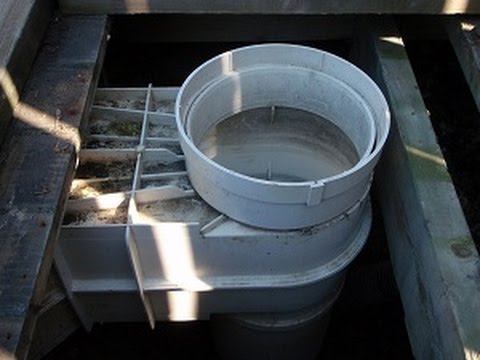
How to winterize inground pool skimmers (with one port) - Most inground skimmers will have dual ports these days but older models of inground pools still might have one, as well as mini skimmers used where no top access is possible which also only have one port. In any case if you have one port only, even if you have two but one was permanently sealed with a plug, then winterizing is simple. Drain the water level in the pool below the mouth of the skimmer. You can vacuum out the standing water in the skimmer body if you want, but if you have a powerful enough blower, which you really should if you want to be winterizing your own pool, then you can skip vacuuming out the skimmer and simply set up the blower through the filtration pump and blow back the entire suction line right from your pump to your skimmer. The water will erupt like a geyser with a powerful enough blower, which you then leave to run for five or ten minutes. This will slowly evacuate the water from the skimmer, with much of the water leaking back into the skimmer only to be blown out again in the geyser. After five or ten minutes there should be nothing left but mist. Turn off the blower and vacuum out the skimmer of any remaining water residual. Pour 1L to 2L (4 to 8 cups) of antifreeze into the pipe and then sleeve a foot of foam rope / backer rod into the pipe opening before installing the gizzmo into the threaded port. If you do not have threads, use an expandable winterizing plug and then add a 1L pop bottle to the skimmer that is 1/3 filled with pool antifreeze. This will float neutrally in the skimmer when it fills with water and give the ice something to crush just like a gizzmo is designed to do. As a final step add 1L to 2L (4 to 8 cups) of pool antifreeze to the skimmer body. Stuffing a few empty bottles with sealed lids into the skimmer body can help as well to protect it from freeze damage. You can not be too careful when it comes to protecting your skimmer. Fixing broken pool skimmers is expensive and can often require additional (expensive) steps that you must also do in conjunction.
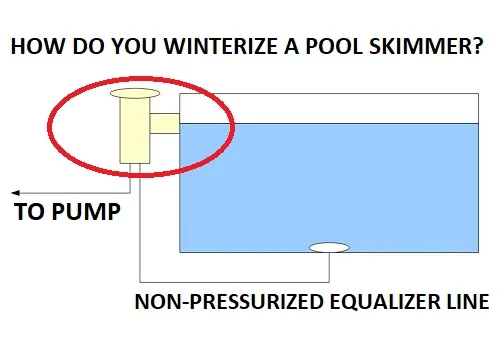
How to winterize inground pool skimmers (with two ports) - This is the pool skimmer configuration that seems to confuse pool owners the most. First, it is the most common arrangement for a pool skimmer plumbing to have, and second, the way to winterize this type of skimmer is not intuitive. If you have dual ports in your skimmer turn your pump off and then check with your fingers to see of both ports are in fact open. Many pools have dual ports on the skimmer where one of the ports gets permanently sealed with a plug from the underside. If this is the case you should be able to feel one of the ports dead end. If one port is plugged, see the example above for how to winterize pool skimmers with one port only, as this is effectively what you have. If both ports are open then one is likely to be an equalizer pipe connecting to a wall port under the skimmer, or more commonly connecting via a non pressurized equalizer pipe to the main drain on the bottom of the pool floor. You can not drain or blow out a skimmer until the equalizer pipe has been dealt with. In most cases the only option to winterize an equalizer port is to add foam rope / backer rod down into the equalizer line. You can drain the pool below the mouth of the skimmer but the equalizer pipe will keep allowing water into the skimmer, so you stuff 12" or more of foam rope down into the equalizer pipe (usually the port closest to the pool walls) and then install a threaded plug, expandable winterizing plug, or a gizzmo. Yes the equalizer pipe still has water in it, but the bottom of the skimmer is a good 12" to 16" below the grade of the deck and surrounding earth, plus adding the foam rope helps to give the ice that might form something to crush instead of splitting the pipes open. Once you have the equalizer port plugged you can now blow out the skimmer from the pump just like in the example step for single port skimmers. You can use two gizzmo products if you choose but only one is really needed so if you use a gizzmo in the equalizer port then just a regular winterizing plug is good enough in the rear port.
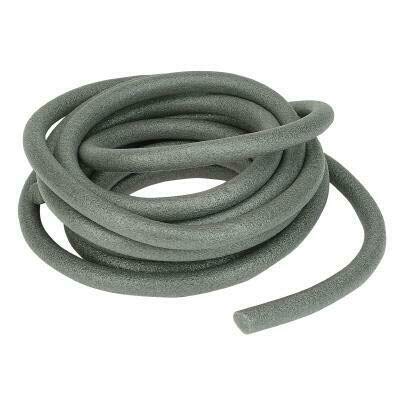
Closed cell foam rope / backer rod

Swimming pool antifreeze

Gizzmo pool skimmer protection
Winterizng pool skimmers is really about layering protection to give you the maximum chance of having no freeze damage. Even the gizzmo products designed to prevent skimmer damage in the winter can fail, and often do, so the first think you do when winterizing a skimmer is to shake the gizzmo to hear if it has taken on any water. So what if this year your gizzmo fails and takes on water. It will no longer protect the skimmer walls against blow out. Well, then hopefully the antifreeze in your skimmer is enough to dilute the water that ends up in there past the point of freezing. If that fails then hopefully the extra bottles you stuffed into the skimmer were enough to protect it from damage. You only need one of these layers of protection to work but if you only have one layer of protection then on the flip side you only need one layer to fail to have a major problem come spring.
8 Part video pool winterizing series
What happens if you drain a pool for the winter?
How to measure & install a pool safety winter cover
Common mistakes pool owners make when opening their pool
Common mistakes pool owners make when opening their pool
How To Open A Swimming Pool In The Spring
Top content from www.SwimmingPoolSteve.com
Pool and spa chemistry crash course
New pool owner guide
The Swimming Pool Steve blog
Have a question - ask Steve

Swimming Pool Steve is an award winning, second generation swimming pool specialist from Ontario Canada and one of the most trusted voices in the swimming pool industry. With over 20,000,000 views on the Swimming Pool Steve YouTube Channel, winner of the Pleatco Pool & Spa Industry Leadership award and author of hundreds of pool and spa articles both online and in print. Steve is committed to helping pool and spa owners as well as pool and spa industry workers learn more about the technical side of building, renovating, repairing and maintaining all types of swimming pools and spas. Follow Swimming Pool Steve on Facebook, Twitter and YouTube.
Paid PDF Books From Swimming Pool Steve
 Steve's Pool Survival Guide
The Swimming Pool Steve Pool Survival Guide is intended to help pool owners understand their pool and pool equipment better, understand water chemistry, water testing and chemical corrections to the water, troubleshoot the most common pool problems and have confidence in interacting and caring for their pool in the fastest possible frame of time. Also covers pool safety, things to avoid and how to operate your pool more efficiently.
 Salt Water Recommendations
Are you considering upgrading to salt water in your pool? In this paid PDF Steve talks about which pools should avoid using salt water. Find out concerns about using salt in your pool but also the potential benefits of salt water. Finally hear which specific brand and model of salt chlorine generator Steve thinks is the best option currently available to pool owners and how to choose the right size salt system for your pool.
 New Pool Heater Buyer's Guide
In this guide Swimming Pool Steve will help you to better understand your heater options as well as which would be best suited for your pool. Learn about BTU output and sizing of both gas/propane heaters as well as electric heat pumps for residential swimming pools. You will also learn about which specific brands and models of currently available pool heaters Steve likes to recommend. If you are thinking of adding a new pool heater to your equipment pad this buyer's guide would be a useful resource to help you make a more informed buying decision.
 New Pool Installation Value Guide
This is a value shopping guide written by Swimming Pool Steve to help home owners hiring for a new pool installation to get the maximum value for their investment with tips about how to protect your interests during the vetting, hiring and pool installation process. Anyone serious about having a pool installed will find value in this guide. Pool installers will sell the pool package that is best for them - not for you! Become an informed value shopper with this PDF guide.
Endorsed Brands From Swimming Pool Steve
The following links and products are to affiliates of the Swimming Pool Steve website. These are brands, products and services hand selected by Steve for endorsement. Please note that these endorsements can include monetary compensation, affiliate links and referral fees to Swimming Pool Steve, however there is zero additional cost to you should you use one of these products or services. Income generated from these links helps to keep this pool and spa resource available for everyone. To have your product or service considered for listing here as an endorsed brand email SwimmingPoolSteve@gmail.com.
Amazon Disclosure Statement - As an Amazon Associate I earn from qualifying purchases.

www.PoolPartsToGo.com
New Black + Decker variable speed pumps are available online from www.PoolPartsToGo.com and they are a drop in replacement for many popular pump models including Pentair Superflo and Hayward Super Pumps. With an adjustable platform base, union connections included and a very strong warranty these pumps offer an impressive value to pool owners.
- Swimming Pool Steve