
3 Steps To A More Efficient Pool
SwimmingPoolSteve.com is user-supported. In order to keep this resource about pools and spas available for free to all readers I earn commissions for purchases made through links on this page. For more information see the full disclaimer page. By using this website you are agreeing to the terms and conditions.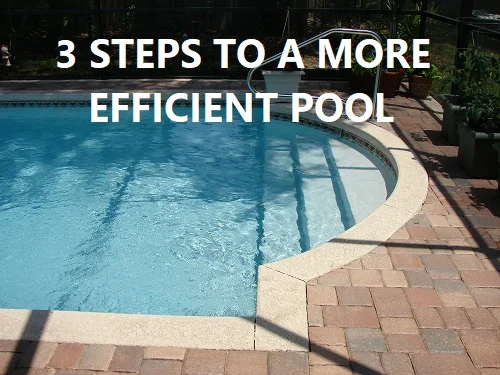
If you are having a new swimming pool installed (or just want to know) here are three specific steps that you can take to make your swimming pool vastly more cost and energy efficient to operate. To a certain extent these ideas can also apply to existing swimming pools as well. In short, pools are not terribly efficient in nature to begin with. First, pools are stagnant water and only via mechanical filtration and chemical treatment do we keep them from becoming a disgusting, bacteria laden swamp. So in essence it is somewhat of an uphill battle to keep a pool in swimming condition simply because both the pool and the nature around your pool really want to become a swamp! You have to work pretty hard to prevent this from happening, but this is where the problems with efficiency start. The process that you use for keeping your pool clean and ready to swim is literally identical to what a pool owner in the 1950's would do. Run the pump and filter, brush and vacuum the pool, and balance the chemicals / chlorine. Can you name any other area of your life where out process today is identical to the one used in the 1950's?
The writing might finally be on the wall to come up with a process that is different than water filtration and chlorine sanitizer but for now that is the best and safest system available for maintaining pool water. So we can not abandon this way of doing things, but we can change it to be more efficient. The cost to operate and maintain an inefficient "average" pool might be in the $250 per month range where that same pool built to operate more efficiently could do so for as little as $50 to $100 per month. But money is not everything. The more efficient pool will use less chlorine and chemicals, which I think is something that all swimmers can appreciate, and in addition to this the water will also be warmer! So not just less money to run, but cleaner water with less chemicals and improved water temperatures to boot! If you are building a pool it would be a huge advantage to you to incorporate these three design elements into your project:

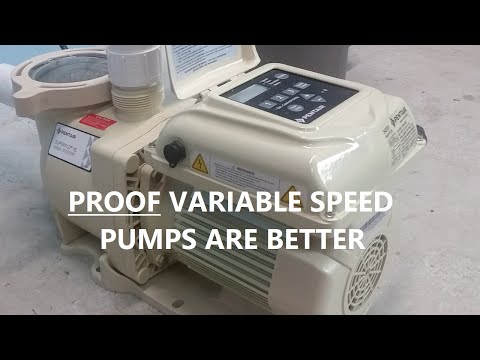
1) Variable Speed Pumps - Easily the most important upgrade that every single swimming pool needs is a variable speed pool pump. It absolutely blows my mind how many people I speak with who are having a pool built and are including a single speed pump. Do you hate your money? It is an advantage to the pool builder to offer you a single speed pump. They are less money to buy and require no programming or education time to the customer. But these are definitely not an advantage to the pool owner. A variable speed pump is an advantage to the pool owner due to improved filtration quality combined with significantly lower daily cost of operation. Running a single speed pump on a timer for part of the day is not comparable to the savings potential of a VS pump due to pump affinity laws which state that there is a non-linear drop in power consumption as the RPM of the motor lowers, while there maintains a linear drop in flow. In short, the RPM goes down a little, the flow goes down a little, the power consumption drops massively. There is no possible argument against the savings potential of a variable speed pump except for ignorance of the science behind how they work. For black and white proof of concept you can take a look at this step by step explanation and presentation: $4300 savings with a variable speed pump.
In addition to the undeniable and massive cost savings potential of variable speed pumps, often reducing the filtration pump operation costs from $150+ to under $40 per month, reducing the velocity of the water as you filter it is actually beneficial for the quality of water filtration as well. So not only is it cheaper to do, by a lot, it actually provides better quality water filtration as well. Some pools with more advanced systems will have additional peripheral items to consider when talking about flow rates. Salt chlorine generators, pool heaters, UV lights, AOP systems all require specific (and minimum) flow levels in order to operate. Fortunately pools rarely need high flow 24 hour per day for peripheral items to run, and items like salt chlorinators which take a long time to generate chlorine every day actually take very little in terms of flow in order to close the mechanical flow switch and safely generate chlorine. This was one of the most common objections against variable speed pumps however as you will see in this video example on this page the flow rates needed to close the flow switch for salt systems are actually quite low: what pump RPM needed for salt system to turn on? This means that even at low RPM operation the salt chlorinator GPM should be easy to meet and exceed.
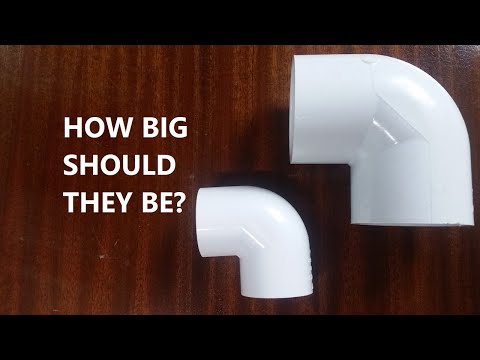
Swimming pools are regulated to have a maximum of six feet per second of water velocity in any suction pipe. This is to prevent swimmers from being exposed to an entrapment hazard from a poorly designed pool. Unfortunately the residential pool market in particular does not always respect these values since there is often little or no oversight / inspection for new swimming pool installations. When you use 1.5" pipes for your suction lines this means that you can only have as much as 38 GPM in that pipe (6 feet per second in 1.5" PVC pipe). 38 GPM is very limiting as far as pool filtration systems go. A 1HP single speed pump could easily put 70 or 80 GPM through a single 1.5" pipe so right away you can see that something is off here. If you run your pump at high speed you will be exceeding the safe water velocity within a suction line, but if you slow down the pump to meet the safe limit, then you are only able to get 38 GPM in that pipe. Fine if you have a tiny 5000 gallon pool, but a pretty big problem for 10k, 20k and 30k gallon pools. As you increase pipe size you increase the amount of water which can move for a set water velocity. If you upgrade the 1.5" pipe to 2" you can go from 38 GPM to 65 GPM. If you go up another size to 2.5" you can now have 90 GPM while still operating under 6 feet per second of water velocity. When paired with a variable speed pump, larger pipes like 2", 2.5" and 3" can increase the flow efficiency of a pool system by 300% to 500%. With small pipes you might only move 15 GPM at low pump motor RPM but that same pump and same RPM could produce many times this amount of flow if you had installed larger pipes for your pool system. Since pipes are such a permanent part of your pool and hard to change in the future, plus they are not a lot of money to upgrade, you should definitely speak with your builder about using larger pipes and building a more efficient plumbing system. For more detailed information about flow rates and pipe size you can read this article about pool pipe sizing.
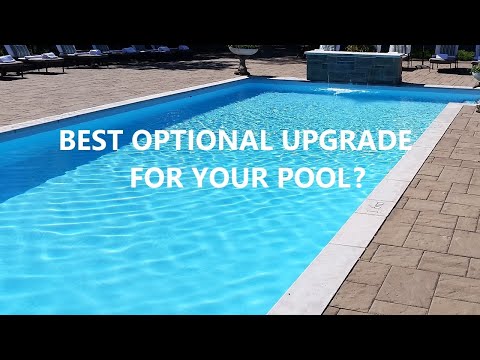
3) Automatic Pool Covers - Automatic pool covers are easily my number one recommendation for new pool owners asking about what value added upgrades they should make to their pool plan. There is nothing that I would endorse more than an automatic pool cover however these are something that is more money and less practical for freeform shaped pools. Rectangle shaped pools are definitely the best shape to get if you want to add an automatic safety cover to your pool. As someone who has been designing and building pools for 30 years I can also say that rectangle pools are the most classic design, provide the most effective swimming and playing area, and are the most cost effective overall. When you consider that rectangle pools are the best option for using with an auto cover this makes the choice heavily weighted towards rectangle pools, at least in my books. In addition to the efficiency and cost benefits, which are great, automatic covers provide safety to your pool by securing the pool area and physically restricting access to the water. Cost savings upgrades are fantastic but life saving upgrades can simply not b measured with price. This is why I promote automatic covers above all else when it comes to new pool installations. It is just a fringe benefit that they also improve heat and chemical efficiency by as much as 95%. Yes you are reading that number correctly.
Heat energy is lost from the pool almost completely by evaporation at the surface of the pool. Contrary to what you might expect, only 5% of heat losses happen from radiation, convection and conduction through the walls and floor of the pool. So when you add an automatic cover to the pool you almost completely eliminate evaporation, which thereby almost completely eliminates your heat and chemical losses which normally escape along with the evaporating water at the pool surface. Yes a regular pool cover like a solar blanket can also provide these energy efficiency improvements with the only problem being the manual nature of putting the cover on and off the pool every day. Some pool owners try to cheat and leave the solar blanket on during the day however this compromises the quality of the diffusion of chlorinated and filtered water and allows concentrated bacteria and algae puddles on top of the cover to develop. These will eventually get washed into the pool when you roll up the cover. If you use a solar blanket you should put it on the pool every night and take it off every morning. The efficiency improvements also make an automatic pool cover worth the expense. The safety benefits should make it a slam dunk for anyone planning a new pool installation...at least rectangle pools anyway. There are some cover options as well for freeform shaped pools, as well as the potential to install a surface mounted rectangle cover that extra-covers freeform shaped pools. I would also recommend to reach out to safety cover manufacturers yourself and find one to work with that you like as opposed to allowing the pool company to supply the safety cover. Almost no pool companies install automatic safety covers so most of the time they are just subcontracting out to the cover manufacturer and installer anyway, and taking a cut for their time.
These are just the very tip of the iceberg when it comes to efficiency improvements you can make for a new pool installation. Investment in smart technology and energy efficient optional upgrades can provide you with drastically reduced monthly costs to care for your pool but it can definitely be overwhelming to many people. If you need help with the design of an efficient swimming pool system then you might want to consider signing up for the Swimming Pool Steve new pool installation consulting service. If you are just looking for more suggestions as to ways you can improve the quality and value of your new pool installation then you might be interested in the value shopping guide written by Swimming Pool Steve. Learn how to interview and hire the right pool builder and make smart design improvements that will provide long term value for your pool: New pool value guide.
Top content from www.SwimmingPoolSteve.com
Pool and spa chemistry crash course
New pool owner guide
The Swimming Pool Steve blog
Have a question - ask Steve

Swimming Pool Steve is an award winning, second generation swimming pool specialist from Ontario Canada and one of the most trusted voices in the swimming pool industry. With over 20,000,000 views on the Swimming Pool Steve YouTube Channel, winner of the Pleatco Pool & Spa Industry Leadership award and author of hundreds of pool and spa articles both online and in print. Steve is committed to helping pool and spa owners as well as pool and spa industry workers learn more about the technical side of building, renovating, repairing and maintaining all types of swimming pools and spas. Follow Swimming Pool Steve on Facebook, Twitter and YouTube.
Paid PDF Books From Swimming Pool Steve
 Steve's Pool Survival Guide
The Swimming Pool Steve Pool Survival Guide is intended to help pool owners understand their pool and pool equipment better, understand water chemistry, water testing and chemical corrections to the water, troubleshoot the most common pool problems and have confidence in interacting and caring for their pool in the fastest possible frame of time. Also covers pool safety, things to avoid and how to operate your pool more efficiently.
 Salt Water Recommendations
Are you considering upgrading to salt water in your pool? In this paid PDF Steve talks about which pools should avoid using salt water. Find out concerns about using salt in your pool but also the potential benefits of salt water. Finally hear which specific brand and model of salt chlorine generator Steve thinks is the best option currently available to pool owners and how to choose the right size salt system for your pool.
 New Pool Heater Buyer's Guide
In this guide Swimming Pool Steve will help you to better understand your heater options as well as which would be best suited for your pool. Learn about BTU output and sizing of both gas/propane heaters as well as electric heat pumps for residential swimming pools. You will also learn about which specific brands and models of currently available pool heaters Steve likes to recommend. If you are thinking of adding a new pool heater to your equipment pad this buyer's guide would be a useful resource to help you make a more informed buying decision.
 New Pool Installation Value Guide
This is a value shopping guide written by Swimming Pool Steve to help home owners hiring for a new pool installation to get the maximum value for their investment with tips about how to protect your interests during the vetting, hiring and pool installation process. Anyone serious about having a pool installed will find value in this guide. Pool installers will sell the pool package that is best for them - not for you! Become an informed value shopper with this PDF guide.
Endorsed Brands From Swimming Pool Steve
The following links and products are to affiliates of the Swimming Pool Steve website. These are brands, products and services hand selected by Steve for endorsement. Please note that these endorsements can include monetary compensation, affiliate links and referral fees to Swimming Pool Steve, however there is zero additional cost to you should you use one of these products or services. Income generated from these links helps to keep this pool and spa resource available for everyone. To have your product or service considered for listing here as an endorsed brand email SwimmingPoolSteve@gmail.com.
Amazon Disclosure Statement - As an Amazon Associate I earn from qualifying purchases.

www.PoolPartsToGo.com
New Black + Decker variable speed pumps are available online from www.PoolPartsToGo.com and they are a drop in replacement for many popular pump models including Pentair Superflo and Hayward Super Pumps. With an adjustable platform base, union connections included and a very strong warranty these pumps offer an impressive value to pool owners.
- Swimming Pool Steve