
When Not To Get A Variable Speed Pump?
SwimmingPoolSteve.com is user-supported. In order to keep this resource about pools and spas available for free to all readers I earn commissions for purchases made through links on this page. For more information see the full disclaimer page. By using this website you are agreeing to the terms and conditions.
Does every pool need a variable speed pump? You might have heard that spring 2021 brings in new requirements for swimming pool filtration pumps and you want to know if you are required to get one. To clarify you are not required to get a variable speed pump for your pool. You are however required to get a filtration pump of minimum efficiency such that the majority of options available to you will end up being variable speed pumps. Variable speed pumps are just so much more energy efficient than single speed pumps that with a new efficiency standard in place 9 out of every 10 pumps available are variable speed. So you can still get a single speed pump for your pool, or a dual speed pump, but the catch is that these pumps must also meet the new efficiency standards. Motors up to one horsepower in size will still be available as single speed and dual speed pumps, but larger than this would need to be variable speed in order to meet the new efficiency standard.
So really this is not about single speed or variable speed at all...this is simply a matter of electrical efficiency. This move is going to impact the industry in a number of ways but one majorly beneficial thing about these changes is that the pump market is about to get a lot more clear for pool owners. It used to be that pumps were sold by horsepower, which is an entirely ineffective way to measure the potential of a pool pump, especially when manufacturers specifically play with numbers and ratings such as true rated motors, up rated, max rated...all this means is that one horsepower pump can be called a 1.5 horsepower pump even though it consumes as much power and moves as much water as the competitors 1.0 horsepower model. Make sense? Yeah, me neither. Don't worry because all that is in the past now. Let's take a look at the new way pool pump motors will be rated.

WEF Rating - The WEF (weighted energy factor) is the new primary method of which swimming pool pump power and efficiency will be measured. Specifically the WEF takes a series of measurements for both flow volume as well as electrical consumption over a spectrum of different motor RPM speeds. These values are then averaged to determine the amount of flow (in thousands of gallons) that a pump can move for a total of 1 kilowatt hour of energy consumed. This means a higher WEF rating is better than a lower WEF as this indicates the pump is able to move more for the same 1kWh of power consumed. So a WEF rating of 8.55 would mean over a spectrum of speed tests the pump is able to move an average of 8550 gallons of water for 1000 Watts of power consumed. This is a vast improvement in how power and efficiency for pool pumps are presented to consumers and will serve to make it much easier for pool owners to make comparisons of efficiency from one pump to the next.
HHP Rating - The HHP (hydraulic horsepower rating) for a pool pump is a calculated value using both system pressure (in PSI) as well as flow rate (in GPM) as part of the calculation. The PSI is multiplied by the GPM and this total is divided by 1714 to reveal the hydraulic horsepower of the pump. As a quick comparison the HHP is equal to approximately half of the total horsepower rating for the pump. Another method to calculate the HHP rating for a pump, depending on what information is available to you, is to multiply the flow (in GPM) by the head pressure (in Ft) and divide this total by 3960 to get the hydraulic horsepower of the pump.
What is the point of changing all of the pump motor ratings anyway? It used to be that you would shop for a pump and you would see a 1.0 horsepower pump with a service factor of 1.65 and a 1.5 horsepower pump with a service factor of 1.0. The service factor is confusing to the average pool pump shopper, but the 1.0 horsepower and 1.5 horsepower ratings seem straight forward. Unfortunately that is not the case. Total horsepower is rated horsepower multiplied by the service factor of the motor. That means the 1.0 horsepower pump with a 1.65 service factor has a total horsepower of 1.65. The 1.5 horsepower pump with a service factor rating of 1.0 has a total horsepower of 1.5. So it is actually the smaller of the two pumps which is more powerful. This created an extremely confusing market with no effective way to create equal comparisons between different pumps. That is the point of the new pump efficiency rating systems. Now it will be easy to see which pumps are more powerful, and which pumps are more energy efficient at moving water. This is what the WEF and HHP ratings can tell you about a pump.
Large Pools Benefit Least From Variable Speed
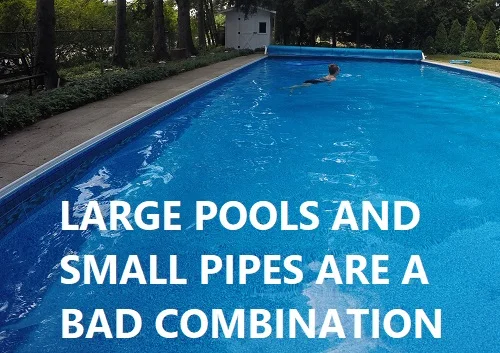
Is there any instance where a variable speed pump is not worth it to get? Actually yes there are some occasions where a variable speed pump may not be worth the additional investment. To clarify, you can still buy single speed pumps for use as a filtration pump for your pool so long as it is less than 1.0 total horsepower in size. It is possible for some high efficiency smaller single speed pumps to meet the new efficiency guidelines. But why would anyone want a single speed pump when variable speed pumps are so much better? Let's take a look at an example pool that would not really benefit from upgrading to a variable speed pump.
In this example we will be looking at an older, existing pool installation. In this example the pool is a large 20x40' rectangle pool with a nine foot deep end which makes the average depth of the pool six feet deep. This makes the approximate volume of this pool right around 36,000 gallons which is quite large for residential swimming pools. Older pools in the 70's and 80's were very commonly 20x40' in size with a deep end however modern day pools are much smaller due to the high chemical and heating costs associated with huge swimming pools. As with many older pools in this example the entire pool plumbing system was plumbed with 1.5" sized pipe. This is very small for a pool this large and a modern day pool of this volume designed more efficiently would have pipes much larger than 1.5" as this has a dramatic impact on the overall potential for efficiency of the system.
Pool size: 20x40' rectangle
Pool volume: 36,000 gallons
Filtration goal: 108,000 gallons
Pipe size: 1.5" PVC
Maximum 24 hour efficient filtration: 54,720 gallons
Maximum pool size for efficient filtration: 18,240 gallons
In this example the filtration goal is 108,000 gallons as this represents three times the volume of the pool. This equates to approximately 95% of the volume of the pool being filtered every day. Unfortunately with pipes so small the amount of efficient water flow that can be achieved is far less than what the pool needs to have every day. No matter which pool pump that you choose you will have a hard time exceeding the range of 80 GPM with a 1.5" plumbing system. This means a soft maximum of 4800 gallons per hour, which after 24 hours would equal 115,200 gallons. Basically this system would need to run on maximum speed 24 hours per day just to meet the filtration goal of 108,000 gallons daily. This leaves very little opportunity for savings with a variable speed pump as any reduction in RPM for the filtration schedule would almost certainly result in the pool no longer meeting the filtration goal we have established.
When it comes to hydraulic systems and pool pipes you have two numbers you need to be aware of. One is the maximum flow volume. As identified the maximum flow volume for 1.5" PVC pipe is in the range of 80 GPM or so. You can perhaps get a little more than this by oversizing the pump but not much more. The other number that you need to be aware of is the value for efficient flow. Water moves very efficiently when in laminar flow, which is to say flow without turbulence. Slow moving water experiences very little resistance to flow however fast moving water experiences a great deal of resistance to flow from friction and turbulence.
The maximum value for efficient water flow in 1.5" PVC pipes is only 38 GPM or so. Beyond this volume of water in a 1.5" pipe there is a steep increase in friction and turbulence. Variable speed pumps save money by operating as much as possible within the limits of slow moving, efficient water. For more information about efficient flow rates for pool plumbing you can read this article about pipe size for swimming pool systems. For this large swimming pool to filter enough water daily you would need to operate the pump at the maximum speed, which is very inefficient for water movement. A variable speed pump would reduce the cost of electricity to run the pump, but any reduction in pump volume would drop the totals below the daily filtration goal.
In this example the pool is simply too large and the plumbing lines simply too small to benefit from any efficiency improvements to the system from a variable speed pump. In this example the pool requires a pump to operate at 24 hours per day at the maximum possible (highly inefficient) flow rate of 80+ GPM just to meet the daily filtration goal. A 36,000 gallon pool with 1.5" pipes can just barely filter enough water and there is no room to improve the efficiency of the system unless the size of the plumbing is revisited. When designed with efficiency in mind a pool this large should have 3" or 4" PVC pipes if not even larger than this in order to allow the system to operate within the limits of efficient flow while still meeting the daily filtration goals for the pool.
When properly built and plumbed with adequately sized pipes almost every swimming pool will benefit from upgrading to a variable speed filtration pump. To see some examples of this you can read this article which shows a $4300 savings from upgrading to a variable speed pump. You can also read this article which looks at small swimming pools to see variable speed pump savings for small pools. This article looks at variable speed pumps for above ground pools. Finally you can also review this article that looks at the what is the cheapest way to filter pool water. If you want more answers about how well a variable speed pump will work for your pool you will likely find answers in these articles. Of course you can always ask Steve if you have a pool pump related question that you can't find an answer to.
Top content from www.SwimmingPoolSteve.com
Pool and spa chemistry crash course
New pool owner guide
The Swimming Pool Steve blog
Have a question - ask Steve

Swimming Pool Steve is an award winning, second generation swimming pool specialist from Ontario Canada and one of the most trusted voices in the swimming pool industry. With over 20,000,000 views on the Swimming Pool Steve YouTube Channel, winner of the Pleatco Pool & Spa Industry Leadership award and author of hundreds of pool and spa articles both online and in print. Steve is committed to helping pool and spa owners as well as pool and spa industry workers learn more about the technical side of building, renovating, repairing and maintaining all types of swimming pools and spas. Follow Swimming Pool Steve on Facebook, Twitter and YouTube.
Paid PDF Books From Swimming Pool Steve
 Steve's Pool Survival Guide
The Swimming Pool Steve Pool Survival Guide is intended to help pool owners understand their pool and pool equipment better, understand water chemistry, water testing and chemical corrections to the water, troubleshoot the most common pool problems and have confidence in interacting and caring for their pool in the fastest possible frame of time. Also covers pool safety, things to avoid and how to operate your pool more efficiently.
 Salt Water Recommendations
Are you considering upgrading to salt water in your pool? In this paid PDF Steve talks about which pools should avoid using salt water. Find out concerns about using salt in your pool but also the potential benefits of salt water. Finally hear which specific brand and model of salt chlorine generator Steve thinks is the best option currently available to pool owners and how to choose the right size salt system for your pool.
 New Pool Heater Buyer's Guide
In this guide Swimming Pool Steve will help you to better understand your heater options as well as which would be best suited for your pool. Learn about BTU output and sizing of both gas/propane heaters as well as electric heat pumps for residential swimming pools. You will also learn about which specific brands and models of currently available pool heaters Steve likes to recommend. If you are thinking of adding a new pool heater to your equipment pad this buyer's guide would be a useful resource to help you make a more informed buying decision.
 New Pool Installation Value Guide
This is a value shopping guide written by Swimming Pool Steve to help home owners hiring for a new pool installation to get the maximum value for their investment with tips about how to protect your interests during the vetting, hiring and pool installation process. Anyone serious about having a pool installed will find value in this guide. Pool installers will sell the pool package that is best for them - not for you! Become an informed value shopper with this PDF guide.
Endorsed Brands From Swimming Pool Steve
The following links and products are to affiliates of the Swimming Pool Steve website. These are brands, products and services hand selected by Steve for endorsement. Please note that these endorsements can include monetary compensation, affiliate links and referral fees to Swimming Pool Steve, however there is zero additional cost to you should you use one of these products or services. Income generated from these links helps to keep this pool and spa resource available for everyone. To have your product or service considered for listing here as an endorsed brand email SwimmingPoolSteve@gmail.com.
Amazon Disclosure Statement - As an Amazon Associate I earn from qualifying purchases.

www.PoolPartsToGo.com
New Black + Decker variable speed pumps are available online from www.PoolPartsToGo.com and they are a drop in replacement for many popular pump models including Pentair Superflo and Hayward Super Pumps. With an adjustable platform base, union connections included and a very strong warranty these pumps offer an impressive value to pool owners.
- Swimming Pool Steve